Showing posts with label bolchazy. Show all posts

Thursday, March 05, 2020

3 Martia Dementia In-Class Activities (+ Free Printables and More!)


In Martia Dementia 2020, the mythological monsters have returned—all thirty-two of them! If you'd like some materials to use with your students to provide background information on these ancient figures, look no further. Bolchazy-Carducci has created blog posts addressing the artistic, literary, and historical significance of six of these creatures. These posts are an excellent starting point for completing research or acquiring basic knowledge. We are also providing very short summaries of the mythological figures, all contained within a printable PDF. Find the links to these resources below.

Need some ideas for covering this year's Martia Dementia field in class? One simple, quick activity for ensuring a basic familiarity is the game Two Truths and a Lie. Simply print out the mythological monster biography sheet linked below. Cut the sheet into strips so that you can individually assign each figure to a student (or a group of students). After learning a little about their assigned figure, each student then presents two truths and one lie about the monster to the class, which has to guess which is fact and which is fiction.

For a more complex activity, ask students to use the Bolchazy-Carducci materials as a starting point to complete additional research on an assigned monster. Using what they have learned, they then craft a persuasive presentation on why their monster should win all of Martia Dementia. After students have sufficiently debated each figure's merits, they can then vote on which figure "deserves" to win. (In fact, this activity can be used to determine a full-class bracket, though you may want to also incorporate the ancient military leaders into this activity; we will be posting biographies for these figures as well at the bottom of the page.)

Looking for other ideas? This year, we are also pleased to provide some free printables and online activities: we have created all of the pieces for a mythological monster Guess Who?–inspired game, Quis Est? If you have the boards at hand, all you will need to do is print out two sets of small cards to insert in the boards and one set of larger cards. We have also provided colorful backings reminiscent of the color scheme of the original game—print these on the back of your cards if you'd really like to have that 1980s-feel. (If you want a simpler set-up, we can confirm that simply printing the small cards on regular paper and then slipping the paper in front of the game's original cardboard pieces works as well.) Regular Guess Who? rules apply, but with this unusual cast of characters, game play is quite challenging. Students will need to know a lot about these monsters to be able to ask incisive questions (and then, understand the answers and accurately flip down the incorrect monsters). To assist with game play, we are also providing a worksheet that students can complete to assess their knowledge.

As an added bonus, we have a short online activity that students can play to practice what they have learned about the mythological monsters before or after playing Quis Est? This activity, which we are making freely accessible, is built on our Lumina platform. Note that the crossword puzzle is replayable: merely hit "re-start," and a new configuration (with varying sets of words) becomes available. Click here or see the link below to play these online games.

Do you use any class or Latin club activities that incorporate Martia Dementia? Let us know in the comments!

Monster of the Month Blog Posts


Printable Materials


Monday, February 17, 2020

Martia Dementia 2020 (Updated with Voting Survey Link)


Ancient bracketologists, prepare yourself: the sixth annual Bolchazy-Carducci Martia Dementia is now upon us! Last year, mythological monsters battled against a range of ancient authors, politicians, and gods to see who reigned supreme. Nike, goddess of victory, lived up to her name and domain, vanquishing all others. This year, the monsters are back, looking for vengeance. They have some worthy opponents, however: famous military commanders of the ancient world! Will Alexander the Great, a general who never lost a battle in his own time, be a match for the taraxippoi? Or will these horse ghosts spook his trusty steed Bucephalus, forcing Alexander out of the competition? Will Mithridates, famous for his resistance to poison, prevail—or will Nessus, a centaur known for poisoning Heracles, get the best of him? We will only find out with your help!

To the victor—whoever finishes with the best bracket—belong the spoils. Before getting to the prizes, here is the way the competition will work. Please read through the process carefully: this year we are changing how bracket submissions and voting will work.

The Bracket
Starting today, complete and submit a bracket to be eligible for wondrous prizes. Please access and submit your bracket online via the following link: Martia Dementia 2020 bracket.

When you access the online Martia Dementia bracket, click the “Submit your bracket!” button to start making your selections. You will be prompted to enter your name and email address; we need this information so that we can track and notify the winners of the competition once Martia Dementia is completed. After signing up, you will be asked to predict a winner for each game in the bracket.

You will be asked to select a winner for each match-up in the bracket.

Once you have completed all of your selections and have submitted your bracket, you will receive a notice thanking you for your submission:

Once you have completed all selections and submitted your prediction bracket,
you are given the option to view your selections.

If you would like to view your prediction bracket, simply click on the link to “View My Prediction.” We recommend saving a copy of your bracket at this point so that you can keep track of how you are doing as the competition progresses. With our new online submission system, you can also easily share your prediction bracket via email or social media—a great way to show off how you’re doing, or earn some pity points if your bracket is going poorly.

We are also providing a PDF copy of the bracket here (for reference only) in case you would like to print a copy of the bracket and fill one in with your class. However, we are not accepting scanned brackets this year, so make sure that you also submit the bracket online.

Brackets will be accepted through Wednesday, March 18.

The Survey
A voting survey will be made available on Thursday, March 19, where you can vote for your picks. Whichever ancient figures have the most votes by the time the survey closes will advance through the round. Actively participating in the survey betters your chances at winning.

This year, voting surveys will look a little different than in previous years. When it is time to vote for each round, simply access the voting survey bracket (the voting survey has a black background). We will announce via social media when voting for each round has opened; note that during each round, you will vote using the voting bracket rather than the forms used in previous years.
 
We cannot stress enough the importance of voting early and voting often. When the survey goes live, cast your votes! Get your friends to vote for your picks. Teachers, get your students to stuff the survey with favorable votes!

Victori Spolia
This competition is not solely for bringing glory to your favorite ancient figure. Bolchazy-Carducci Publishers is offering book prizes for the brackets that most closely resemble the final results; a $100 book credit will be awarded to the first-place participant, a $50 credit to the second-place participant, and a $25 credit to the third-place participant. Feeling like you no longer stand a chance? Do not give up! There will also be a $25 credit for having the most abysmal bracket! 

Stay Connected
Be sure to bookmark this post and check back starting March 19 to access the link to the voting bracket. Also, follow us on Facebook and Twitter for updates as the competition progresses.

Remember, brackets close Wednesday, March 18, and the first round of voting will begin Thursday, March 19.
                                                                                        
Bracket 
Access the online bracket here 
Access a printable bracket (for reference only) here 

Survey Link—NOW POSTED
Access the survey link here


Voting Schedule:
  • Round 1: March 19 & 20
  • Round 2: March 21 & 22
  • Round 3 (Sweet 16): March 26 & 27
  • Quarterfinals (Elite 8): March 28 & 29
  • Semifinals (Final 4): April 4 & 5
  • Final (Championship): April 6–8

Note that each round of voting will open at 7:30 am central time and close at 4:00 pm central time on the designated days. 


Tuesday, February 11, 2020

Mythological Monster of the Month: Hydra


February’s Roman Calendar Feature

The 2019–2020 Roman Calendar features twelve mythical monsters from the 2019 edition of Martia Dementia, Bolchazy-Carducci’s annual spring bracket tournament. Visit us on social media (FacebookTwitter, and our blog) for announcements regarding the 2020 Martia Dementia—starting later this month!

Behold, the Lernaean Hydra! According to Hesiod, this many-headed serpentine creature was the offspring of Typhon and Echidna, prolific parents of some of Greek mythology’s most famous monsters. An inhabitant of the liminal lake Lerna, the Hydra breathed out poisonous vapors that made the environs nearly impossible for mortals to even approach. Heracles, during his twelve labors, was tasked with slaying the Hydra—no easy feat, especially because as Heracles severed one Hydra head, two more grew in its place. Unable to defeat the Hydra on his own, Heracles asked his nephew Iolaus for help. While Heracles sliced away each head, Iolaus used a firebrand to cauterize the wounds, preventing the Hydra from regenerating.


Hydra, sixth-century bce Caeretan hydria (water vessel) 
(Digital image courtesy of the Getty’s Open Content Program)

A victorious Heracles dipped his arrows in the Hydra’s poisonous blood, creating a potent weapon that helped him accomplish several of his other labors—but would ultimately be his own downfall. The body of the Hydra was placed in the sky as the constellation Hydra, which has a shape resembling a twisting snake. This constellation is the largest of the eighty-eight modern constellations.

The Hydra depicted among eleven other constellations, 
nineteenth-century star chart card from a set known as Urania’s Mirror 
(Public Domain, restored by Adam Cuerden)

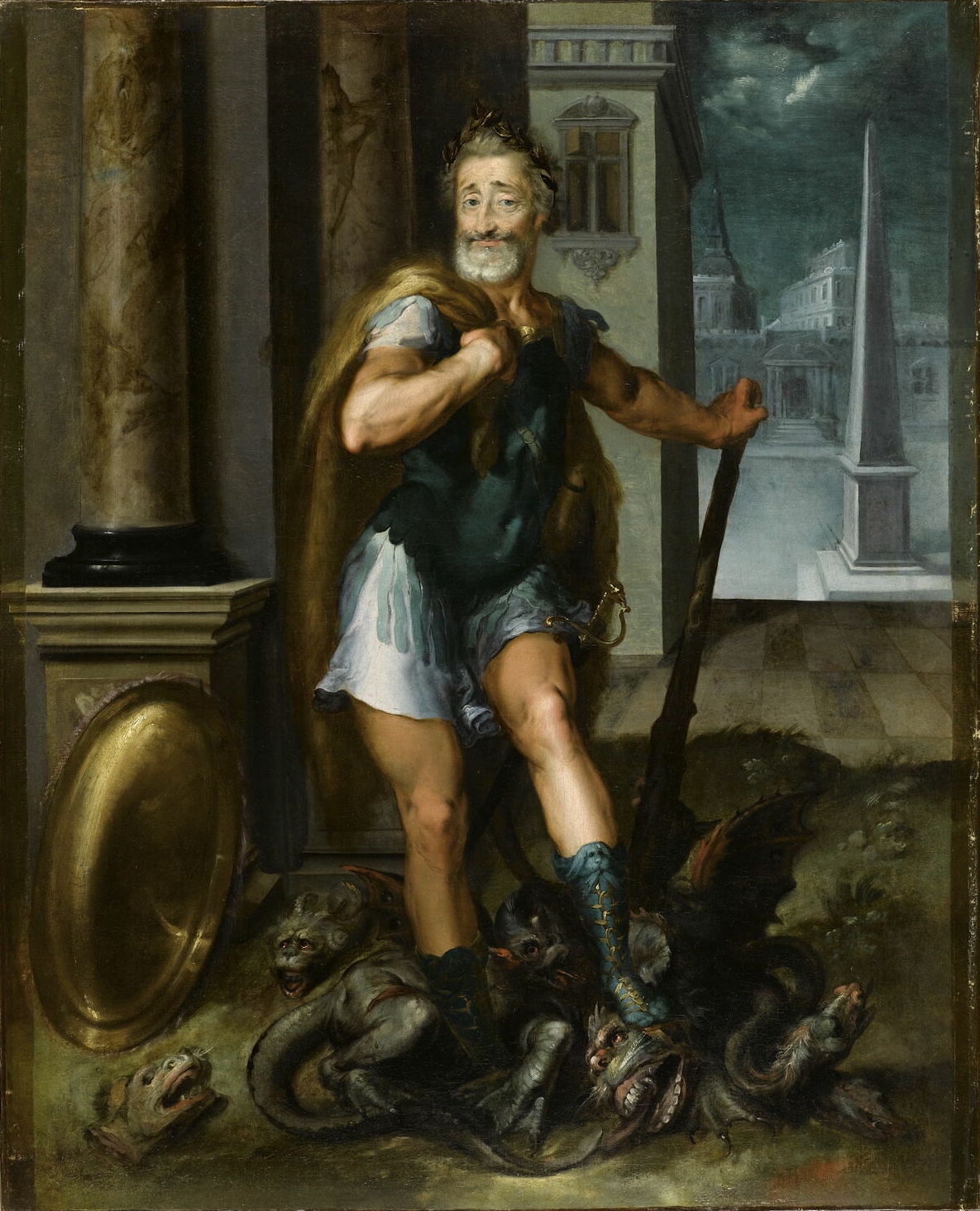
Today, the term “hydra” is often used to refer to an intractable problem that is not easily solved; as when Heracles attempted to slay the mythical Hydra, an attempt to find a solution results in new problems cropping up. King Henry IV of France chose to portray himself as Hercules (the Roman name for Heracles) standing over a vanquished Hydra after he brought an end to France’s internecine religious wars at the end of the sixteenth century. In the painting, Henry—sporting a rather self-satisfied facial expression—casually stands over the beheaded monster, representing his recent political enemy, the Catholic League.

Portrait of Henry IV as Hercules Slaying the Lernaean Hydra by Toussaint Dubreuil (1561–1600) (Public Domain)

Another more modern application of the ancient Hydra occurs in the field of biology: Hydra refers to the genus of fresh-water organisms (related to jellyfish) that have a tubular body featuring a mouth at one end surrounded by an array of tentacles. Like its mythological namesake, a Hydra can regenerate damaged tissue: when cut in half, each half can grow into a whole, complete Hydra. Similarly, like the Lernaean Hydra, these creatures may be quasi-immortal. The same biological factors that allow Hydra to regenerate tissue mean that they do not senesce, or grow old. 

Hydra attached to a substrate (© Creative Commons 
Attribution-Share Alike 3.0 Unported/Stephen Friedt)

The Hydra, with its symbolic and scientific iterations, illustrates how Greek and Roman myth continues to live on in new, often unexpected ways. Students may enjoy discussing other mythological figures that have taken on new meanings in the modern world. 

Still curious about how the ancients described the Hydra? In Ovid’s Metamorphoses (9.67–72) Hercules competes with the river god Achelous for Deianira’s hand in marriage. Taunting the god, he boasts about his victory over the Hydra, a feat that he claims was much more difficult than the one he is about to perform. Here, Hercules claims that the Hydra he vanquished had one-hundred heads!

“cunarum labor est angues superare mearum,”
dixit “et ut vincas alios, Acheloe, dracones,
pars quota Lernaeae serpens eris unus echidnae?
Vulneribus fecunda suis erat illa, nec ullum
de centum numero caput est inpune recisum,
quin gemino cervix herede valentior esset.
Hanc ego ramosam natis e caede colubris
crescentemque malo domui domitamque reclusi.”

“It was the pastime of my cradle days
to strangle better snakes than you—and though
your great length may excel all of your kind,
how small a part of that Lernaean snake
would you—one serpent be? It grew from wounds
I gave (at first it had one-hundred heads)
and every time I severed one head from
its neck two grew there in the place of one,
by which its strength increased. This creature then
outbranching with strong serpents, sprung from death
and thriving on destruction, I destroyed.”

Translation in Ovid’s Metamorphoses by Brookes Moore


–Amelia Wallace, Editor

Thursday, January 09, 2020

Mythological Monster of the Month: Griffin


January’s Roman Calendar Feature
The 2019–2020 Roman Calendar features twelve mythical monsters from the 2019 edition of Martia Dementia, Bolchazy-Carducci’s annual spring bracket tournament. Visit us on social media (FacebookTwitter, and our blog) for announcements regarding the 2020 Martia Dementia.

January’s monster of the month is the majestic griffin, which according to legend had the body of a lion and the head and wings of an eagle. The January image in the 2020 Roman Calendar shows a detail of a griffin taken from a fourth-century BCE tomb painting found in Paestum, Italy. In the full fresco, two griffins—note the leonine hindquarters and tail, massive feathered wings, and curved beaks—attack a panther, poised to pounce.

Two griffins and a panther, Lucanian fresco in the Museo Archeologico Nazionale
(© Creative Commons Attribution-Share Alike 3.0 Unported/Sailko)
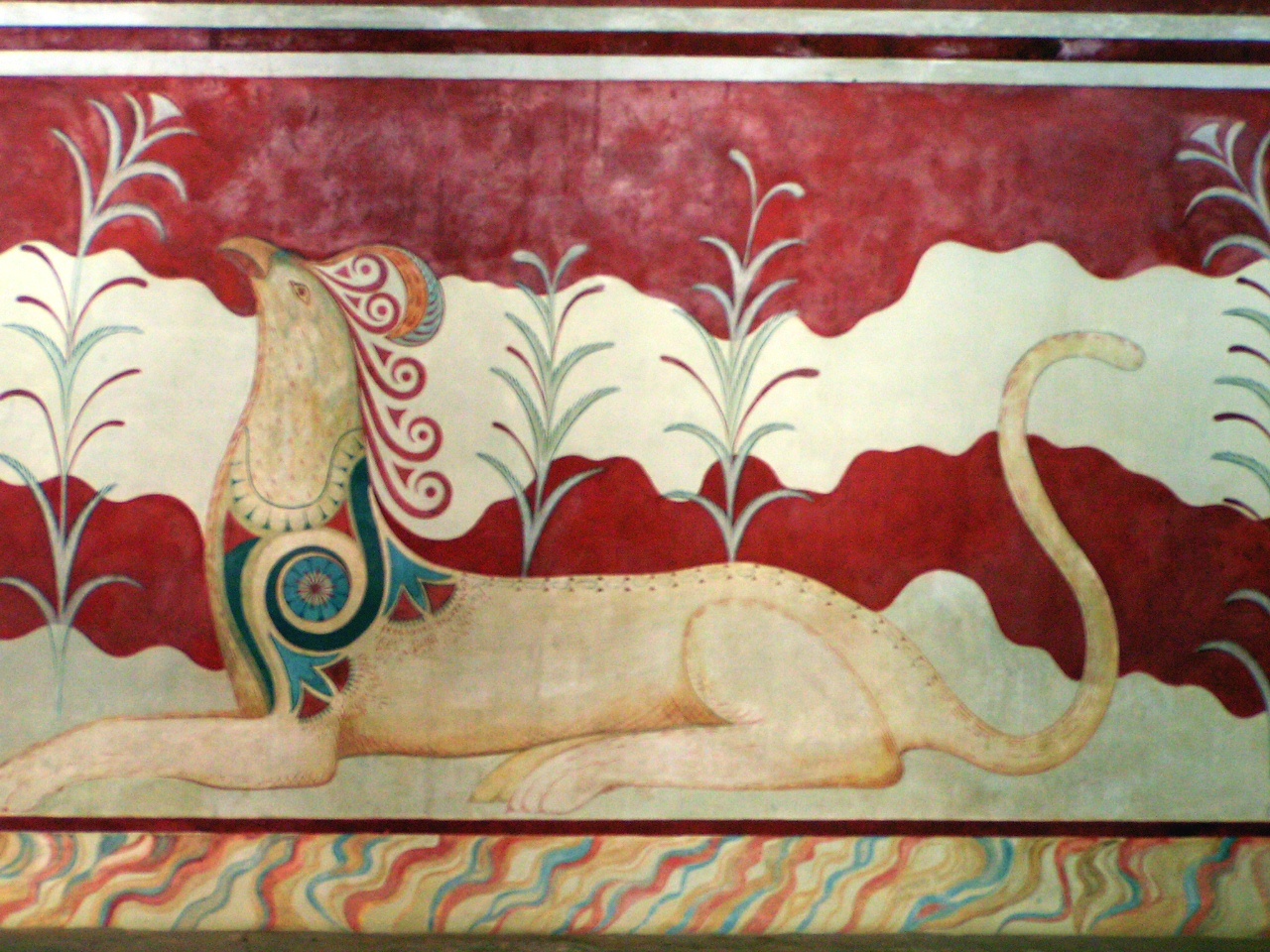
The griffin’s mythical origins lie in the ancient near east and Egypt, with depictions of the creature first appearing around 3,000 BCE. By the fifteenth century BCE, griffin imagery had made its way to the Greek world: the hybrid beast was vibrantly portrayed in a fresco found in the “Throne Room” in the Palace of Knossos on Crete. The griffin remained a popular artistic motif in much of the ancient Mediterranean world, and its prominence continued into the medieval era, when the griffin became a common symbol in heraldry. Griffins were not only used in medieval Christian art, but also in Islamic art of the same time period. The Pisa Griffin, a massive bronze sculpture created in eleventh-century Al-Andalus (modern-day Spain), incorporates Arabic text and patterns associated with textile designs.

 Griffin fresco in the “Throne Room,” Palace of Knossos, Crete
(© Creative Commons Attribution-Share Alike 3.0 Unported/Paginazero)

The Pisa Griffin, an eleventh-century bronze now in the Pisa Cathedral, was originally
 a fountain spout (© Creative Commons Attribution-Share Alike 3.0 Unported/Memorato)

While there are few early written accounts of the griffin, several Greek and Roman writers described griffins as the guardians of gold deposits located in Anatolia, Central Asia, or India. Various authors, including Pliny the Elder (see excerpt below), have detailed the enmity between the griffins and the Arimaspians, a neighboring tribe of one-eyed men who perpetually tried to steal the griffins’ gold. These legends of the griffin continued into the middle ages, and griffins were frequently featured in medieval bestiaries. The griffin still captures the imagination of writers today: the griffin makes an appearance in The Sons of Neptune by Rick Riordan. In the Harry Potter series by J.K. Rowling, Harry and his friends are sorted into the Hogwarts house of Gryffindor, a name that evokes the bravery, strength—and even the ferocity—of the mythical griffin. The hippogriff, a related creature that is half-lion, half-horse, plays an important role in Rowling’s Harry Potter and the Prisoner of Azkaban.

When discussing with students, ask where else they have seen the griffin. Answers may include other stories or literature, as well as architectural motifs, coats of arms, and logos.

Pliny’s Account

In the passage excerpted below from Natural History 7.10, Pliny describes the battles between the Arimaspians and the monstrous griffins, citing Herodotus and Aristeas of Proconnesus as his sources:
 
sed iuxta eos, qui sunt ad septentrionem versi, haut procul ab ipso aquilonis exortu specuque eius dicto, quem locum Gesclithron appellant, produntur Arimaspi, quos diximus, uno oculo in fronte media insignes. quibus adsidue bellum esse circa metalla cum Grypis, ferarum volucri genere, quale vulgo traditur, eruente ex cuniculis aurum, mira cupiditate et feris custodientibus et Arimaspis rapientibus, multi, sed maxime inlustres Herodotus et Aristeas Proconnesius scribunt.
In the vicinity also of those who dwell in the northern regions, and not far from the spot from which the north wind arises, and the place which is called its cave, and is known by the name of Geskleithron, the Arimaspians are said to exist, whom I have previously mentioned, a nation remarkable for having but one eye, and that placed in the middle of the forehead. This race is said to carry on a perpetual warfare with the Griffins, a kind of monster, with wings, as they are commonly represented, for the gold which they dig out of the mines, and which these wild beasts retain and keep watch over with a singular degree of cupidity, while the Arimaspians are equally desirous to get possession of it. Many authors have stated to this effect, among the most illustrious of whom are Herodotus and Aristeas of Proconnesus.
translation in The Natural History of Pliny the Elder by John Bostock


—Amelia Wallace, Editor


Friday, November 08, 2019

Dolus aut Dulce 2019 Winners


Amy Bernard-Mason and her son
as Medusa and Perseus.
After due deliberation on the Dolus aut Dulce entries, Bolchazy-Carducci editors have come to a decision! Plurimas gratias to all who participated in our annual classics costume contest, expanded this year to include a classroom decoration category. From a modern maenad to Persephone with pomegranate . . . to Elmo in a toga (yes, seriously!) and more, we loved seeing the various ways in which contestants interpreted the classical world in costume form. Classroom décor tended toward the macabre, with tombstones and underworld-related iconography emerging as major themes.

Congratulations are in order for Amy Bernard-Mason, Latin teacher at Voorhees High School and North Hunterdon High School in New Jersey. The winner of this year’s costume category dressed as Medusa to her son’s Perseus; in their submission, the young hero is in the process of slaying his monster mom. Amy has kindly provided some more photos from her trunk or treat event this year, in which she recreated Aunty Em’s Garden Gnome Emporium from the Percy Jackson young adult mythology series. Check out the Medusa crime scene chalk outline!
Amy Bernard-Mason's Medusa crime scene
chalk outline. 

Our second winner transformed her classroom into the Greek underworld with the help of her middle school classes. Emma Vanderpool, Latin teacher at Trickum Middle School in Lilburn, Georgia, asked her students to create museum displays for the multitude of monsters that inhabit Hades. The result was a spine-chilling spectacle. See below for an explanation of her assignment. If you’d like to do something similar in your class, you may also want to use Bolchazy-Carducci’s monster of the month calendar blogs (read September’s blog here and October’s here). 

Did you miss out on this year's Halloween contest? Be sure to follow us on Twitter and like us on Facebook to keep up to date with upcoming contests, new books, and conference and webinar schedules! 
  

Emma Vanderpool’s Greek Underworld Museum Display Assignment

Create a life-size decoration for the wall depicting an assigned underworld figure or monster
  • must be in color
  • may have items printed out (ask Magistra)

Create a museum card (with group members’ names and a four to five sentence summary of figure).

Counts as a test grade for culture
  • 10 points for accuracy
  • 5 points for creativity
  • 5 points for effort

Assigned figures, entrance of the underworld
  • Charon: ferryman of the dead
  • Hermes: guide of souls to the underworld
  • Cerberus: multiheaded dog and guardian of the underworld
  • Gorgons: snake-haired monsters with a deadly stare
  • Geryon: fearsome giant with many heads (and sometimes, bodies)
  • Chimera: a fire-breathing hybrid monster
  • Centaurs: hybrid horse-human creatures
  • Furies: goddesses of vengeance
  • Fates: three goddesses who decided the fate of humans and gods
  • Judges: Minos, Rhadamanthus, and Aeacus
  • Hydra: snake-headed water monster
  • Harpies: half-human half-bird figures
  • Personification of grief (penthos), anxiety (cura), diseases (nosoi), old age (geras), fear (phobos), hunger (limos), need (aporia), death (thanatos), agony (algea), sleep (hypnos), war (polemos), and discord (eris)

Assigned figures, Tartarus inmates
  • Danaides: condemned to carry water in a sieve for eternity
  • Ixion: bound to a fiery wheel in the afterlife
  • Sisyphus: forced to perpetually push a heavy boulder up a hill
  • Tantalus: eternally unable to reach food and drink just beyond his grasp
  • Tityus: tortured by vultures who ate his liver, which regrew daily
  • Titans: the twelve pre-Olympian gods

To see how Emma's classroom transformation turned out, check out the following video!


Tuesday, July 19, 2016

Acquaintances and Awards in Austin: An ACL 2016 Wrap-Up

Editor Don Sprague sits behind the
Bolchazy-Carducci book display 
at the 69th Annual ACL in Austin, TX
The 69th Annual Institute of the American Classical League took place at the University of Texas in Austin, TX Sunday June 26 through Tuesday June 28, 2016 with 280 in attendance. Allan Bolchazy, Don Sprague, and Laurel Draper represented Bolchazy-Carducci. The daytime temperatures in Austin were in the 90’s and the humidity quite high.


ACL President Kathy Elifrits
presenting Rose Williams
with the Merita Award.
The exhibit space was at the San Jacinto Center in a nice open and light-filled room with plenty of space for folks to move around. Registration and break refreshments were in the same room. B-C prepared a special display for the book exhibit that included all of Rose Williams’s B-C books, a poster, and a bouquet of yellow roses.

Nancy Yust, one of two winners
of the B-C book bundles "fishbowl"
drawing, displaying her
winnings at ACL in Austin.
One of the highlights of the Institute was the Meritus/Merita Award presentation at the banquet. Rose Williams received the Merita Award and B-C author Gaylan DuBose (Farrago Latina: A Teacher Resource and, with Marianthe Colakis, Excelability in Advanced Latin) received the Meritus Award. Ginny Lindzey (Gaylan's former student who teaches Latin at Dripping Hills High School, TX) won the Norman Goldman costume award.
Kathleen Durkin, one of two winners B-C
book bundle drawings, happily holds her
newly obtained books.

Another highlight of the Institute was the Bolchazy-Carducci "fishbowl" drawing. This year we again offered two book bundles. Congratulations to the winners! Nancy Yust and Kathleen Durkin each took home a bundle of books. When attending conferences, always be sure to stop by our booth, so that you don't miss an opportunity to win prizes.

Overall we had a great time talking with friends, customers, and all attendees. Were you unable to make the conference and still have questions? Did you attend and would you like to share a part of your experience? Feel free to comment or ask questions below. I'd love to hear from you!

-Connor Hart

Tuesday, March 01, 2016

Vocabulary Quizzes for Ubi Fera Sunt

Recently Bolchazy-Carducci announced the arrival of Ubi Fera Sunt, a Latin translation  by Rick A. LaFleur of Maurice Sendak's beloved Where the Wild Things Are. The book, with its limited vocabulary, makes a great addition to Latin classrooms of any level. To help make it an effective resource in the classroom, we have provided links to several quizzes that will make it fun and easy for students to master the vocabulary. Quizzes and instructions on how to use each format  can be found on our web page here, under the "Digital Content" tab.

One platform, Quia, functions as either a take-home quiz for the students to finish for practice on their own or as one for the students to complete during class. It lists the Latin or English for the students and they must type in the correct translation.

The other platform, Kahoot, is primarily an in-class quiz. The teacher displays a Latin word with four possible translations, and it is up to the student to choose the correct one.

For teachers who don't use Quia or Kahoot, LaFleur has also provided a complete vocabulary list, divided by parts of speech, which is also available under the "Digital Content" tab.

Friday, December 11, 2015

Ubi Fera Sunt: Where the Wild Things Are in Latin

Bolchazy-Carducci Publishers is proud to announce the arrival of Ubi Fera Sunt, the first published Latin translation (by Richard A. LaFleur) of the beloved children's story Where the Wild Things Are, by Maurice Sendak. This lively translation faithfully and playfully recasts Sendak’s unique writing style into classical Latin. It includes the beautifully remastered images employed in the fiftieth anniversary edition. Where the Wild Things Are has been published in numerous other languages, including French, German, Spanish, Hebrew, and even Finnish, but never until now into classical Latin.

Richard A. LaFleur, a.k.a. Doctor Illa Flora, has provided resources to enhance the classroom experience for his Latin translation. "Why NOT a Latin Wild Things" offers insight as to why LaFleur decided to translate Sendak's work and his hopes that "this modern rendering of his . . . charming classic" will join the Latin canon alongside other children's classics such as Winne Ille Pu and Cattus Petasatus. LaFleur has also provided an "About the Translation" resource to explain his always correct, but at times "Sendakian," choices in Latin. "Pronouncing Latin" gives Latin readers a refresher on pronunciation, while it also serves as a great tool for those learning and new to Latin. Lastly, LaFleur offers a glossary of all the Latin words employed in his translation. These resources are all designed to make Ubi Fera Sunt as effective a classroom component as it is a fun one.

Tuesday, April 14, 2015

Lucan Wins: Recap of Martia Dementia

Lucan Wins: Recap of Martia Dementia
The End and Future of Martia Dementia

An image of the final
Marita Dementia bracket
Euclid learned all too well last weekend, which marked the conclusion of the 2015 Martia Dementia, that all good things come to an end. His Cinderella story included a narrow victory over the No. 1 Seed Plato, a marginal triumph over Aristophanes, and pivotal victory over the increasingly popular Xenophon. Some believed that the No. 10 Seed Aeschylus, advancing to the Elite Eight, might stop him, but no, that honor went to Lucan. Lucan, the prolific writer of many titles and epigrams. Lucan, who beat the esteemed Apuleius just a day after upstaging Augustine, and who even pulled out a few tricks from his De bello civili for a victory over the heavily favored Vergil. Lucan beat Euclid 13-2 to take home the glory, thus winning Martia Dementia. Many narratives sprouted from the bracket as voting created conflict between these authors of antiquity, and many surprises came as dark horses produced upset after upset; Hesiod, a four seed, was the highest ranked author to advance past the Elite Eight! These narratives, and the success of Martia Dementia, all happened thanks to our participants.


An image of Marie's
final bracket.
The initial response to Martia Dementia was overwhelming, but thinking that the number of participants would match this was a dream, though it soon became a reality as bracket after bracket began to flood my email. With that, I would like to thank all the teachers, professors, friends, students, and everyone else for their participation. I would also like to take time to acknowledge and congratulate the following for their success in this year's competition. First, to our in-house winner, Marie Bolchazy who, though not in the running for prizes, put up enough points to take second place. Now, to Sabrina Epstein of the Bullis School who, with only three picks remaining after the Round of 32, never gave up hope, I say congratulations for having the most abysmal bracket! To Evelyn Beckman, also of the Bullis School, to whom I am partial for also going with team Ovid, I would like to say congratulations for picking up 48 points and taking third place! To Inna Kunz, whose faith in Lucretius allowed her to just squeak by with a 49-point effort, I would like to say congratulations for finishing in second place! Lastly, I congratulate Thanh Tran who, with 128 points and a near-perfect bracket, won this year's Martia Dementia by a landslide! 

If you were disappointed in how your bracket went this year and wish to prepare for a better outing next time, Tran shared her winning strategy, making it seem easy, saying, "I basically chose the authors whom I liked best in each pairing if not entirely at random." Still, a little more effort and a little outside support helped to make a winning bracket: "I may have asked a lot of my students to vote for my bracket." So there you have it, the winning strategy: a little randomness and a lot of votes.
This Attic red figure vase, found in the University
Museum, University of Pennsylvania, shows Hercules
wrestling with the Nemean lion.

Looking forward to next year's Martia Dementia? Already counting down the days? Want to see a favorite author who did not make this year's cut? Would you rather see gods and goddesses versus heroes versus beasts? Perhaps you prefer political bouts? Tweet @BCPublishers what and who you would like to see, and include the hash tag #MartiaDementia or give feedback in the comments below. Did you have questions or comments about how this year's competition went? Were you able to find ways to incorporate Martia Dementia into the classroom, or do you have ideas of how you might next year? Comment below; I would love to hear from you!

-Connor Hart

Tuesday, March 10, 2015

Martia Dementia in the Classroom

Martia Dementia in the Classroom

The excitement of Martia Dementia has stirred up a considerable amount of internet buzz in the classics community. Our Facebook, Twitter, and BlogSpot have all seen a lively amount of activity. Now the brackets are live (and already coming in!) and the surveys ready for launch next week. Still, one question sits like an elephant in the room: How can Martia Dementia serve not just as a rewarding competition but also as something rewarding in the classroom?
An image of the BC Bracket, now
available on Twitter and our blog.

Teachers should see Martia Dementia as an opportunity for students to learn about authors they may not normally cover, or even hear about, in the standard Latin or Greek classroom. One way is for teachers to have students take a look at the bracket and pick an author they would like to present, by themselves or in groups. Depending on time, this could be a one-minute activity, where students give two important facts and one "fun" fact about the author (the "fun fact perhaps resembling something I attempted with the survey, which you will see in due time). To save time, I have already created a document so students do not have to dig up the information themselves. If allotted more time to present, students will have the opportunity to present a more expansive biography of the authors to the class.

Another way to turn Martia Dementia into a fun classroom activity is to play "Two Truths and a Lie." This option serves as a chance for students to get creative and have fun while still learning. Teachers may choose to assign authors to individuals or perhaps groups of three, or allow them to pick their own. Then the goal is for students to find and generate two truths and one lie about each author. As a group, two students can pose as truths and one as the lie and have the class guess which is posing as the lie. This task can take the form of simple presentations or can also serve as a competition where students aim to find he most ridiculous truths and make their lies so believable that they stump the classroom.

Seize the opportunity to have fun with Martia Dementia! Have you started to already? Do you have other ideas as to how you might use this in your classroom? We would love to hear your thoughts and ideas in the comments below!

-Connor Hart

Tuesday, March 03, 2015

Scandal Surrounds Martia Dementia

Scandal Surrounds Martia Dementia:
Confusion and Scandal Strike Soon After Finalized Bracket Is Released

Confusion has led to scandal here in Chicago as Martia Dementia rapidly approaches. The finalized bracket, released this past Monday, March 2, sparked cries ranging from “foul” to “outrage” that could be heard from Ilium to Illinois.

Late last night, Seneca the Elder was seen going into the very locker room his son occupied earlier that day. This led to the belief that lack of specification on the bracket was their way of covering up the fact that both would try to compete to gain votes. Though his father could not be reached for comment, the underdog Seneca the Younger spoke out on their behalf: "Calamitās virtūtis occāsiō est" (“Disaster is the opportunity for bravery”). We also reached out to his first-round opponent, Petronius, and asked if he had any comment, to which the favorite, in a very Senecan way, replied, "Nōn est vir fortis ac strēnuus quī labōrem fugit" (“The person who runs away from hard work is not a brave and active man”). We expect neither participant will back down from the competition after this.
Someone spied Pliny the Younger reaching out
to his uncle Pliny the Elder late last night.

As if this father-son attempt at rigging the competition were not enough, an outside source spied Pliny the Younger writing letters to his uncle for help in his match-up against the lower-seeded Martial. Martial, not expected to receive much help from votes, hopes the committee will leverage sanctions against Pliny the Younger. As of today, the committee has yet to determine whether or how to penalize either familial pair for their scandalous attempts.

On the eastern side of the bracket, many were confused to find the 16-seed assumed not by a Greek but by the Christian apologist Lactantius. This play-in position pits Lactantius, a dark horse, against the top seed on the Greek side of the bracket. Though reporters could not reach Lactantius for comments his opponent Homer, considered the tournament's favorite by many, had a few words to say when asked about not playing a Greek in his first round: "Not a Greek, but a Roman? ἄνδρα μοι ἔννεπε. And what of the Achaeans?"

There you have it! Competition is heating up in the early stages of the tournament. Stay tuned for more pregame interviews, smack talk, and more from our fierce competitors. Also, don't forget to download your bracket and cast your votes!

-Connor Hart

Friday, February 27, 2015

Martia Dementia

Martia Dementia:
Ancient Author March Madness

April showers bring May flowers, but March brings the madness, and this next month Bolchazy-Carducci Publishers will bring March Madness to the ancient world. We have created a bracket of 64 ancient authors, 32 Latin and 32 Greek, one of whom will reign supreme. How will one author rise above the others as champion of the Mediterranean? The answer is you. To the victor belong the spoils, and whoever finishes with the best bracket, spoils await, but before the prizes, here is the way the competition will work.

A volute krater in the British Museum depicts
a fight between Achilles and Hector.
The Bracket
There are two parts to the participation in this event; the first is the bracket. Contestants will need to download a bracket from below, when made available, and save it as a PDF file. Having done this, simply advance the authors of your choosing through the bracket, writing in your picks and eliminating the others, until one remains above the rest. Once filled out, send the bracket along to the email provided on the bracket. The rankings are random. There is no rater’s index or previous statistics to consider, and no author has an advantage over another. The only factor determining an author’s advancement is your participation. Filling out the bracket to be eligible for the prizes is the minimum requirement.

The Survey
To further improve your chances of winning, a survey will be available for each round (below) where you can vote for your picks or, as it gets closer to the championship, vote against any picks that might hurt your chances of winning. This aspect is separate from the bracket and not necessarily required, but actively participating in the survey betters your chances at winning. We will determine the victors of each match by who has the most survey votes by the time the survey closes.

As a company based out of the Chicago area, we cannot stress enough the importance of voting early and voting often. So when the survey goes live, cast your votes; get your friends to vote for your picks; teachers, get your students to stuff the survey with favorable votes.

Victori Spolia
The competition is not solely for bringing posthumous glory to your favorite ancient author. Bolchazy-Carducci Publishers is offering book prizes for the brackets that most closely resemble the final results; a $100 book credit will be awarded to the first-place participant, a $50 credit to the second-place participant, and a $25 credit to the person finishing in third place. Feeling like you no longer stand a chance? Do not give up! There will also be a $25 credit for having the most abysmal bracket! So get ready, and stay tuned. Brackets will be available next week and the voting madness begins March 19!

-Connor Hart

Be sure to bookmark this post, as we will post the survey links for each round as they become available here:

Bracket

Round of 64

Round of 32

Sweet Sixteen

Elite Eight

Final Four

Championship Round