Showing posts with label Hydra. Show all posts

Monday, April 13, 2020

Alexander the Great Wins: Martia Dementia 2020 Recap

A Roman copy of a third-century Greek bust of Alexander the Great, with
characteristic "leonine mane." (© Creative Commons 
Attribution 2.0 Generic/Richard Mortel)
In this year’s Martia Dementia face-off between mythological monsters and military leaders of the ancient world, the monsters gained an edge early in the contest—suggesting that supernatural powers might always trump a talent for battle formations and ingenuity in warfare. However, Alexander the Great proved an early contender, handily beating the taraxippoi, or horse ghosts, which were no match for Alexander’s trusty steed Bucephalus. Another general with some early successes, Constantine the Great, struggled against the Erinyes, who hoped to gain vengeance for all of the family members that the emperor slaughtered in his rise to power. Constantine was triumphant, though, continuing all the way to the Elite Eight, when he was unable to hold out against the Hydra. 

Most contests, nonetheless, reinforced the utter dominance of mythological creatures. Nessus, bearing Heracles’s poison-dipped arrow, overcame the defenses of Mithridates, the so-called Poison King, whose famed resistance to potent potions was poor protection in this instance. Creatures from the likes of the Minotaur to the harpies to Scylla and Charbydis all moved past the first round without difficulties. Medusa proved most powerful of all, her stony glare defeating opponent after opponent. 

The final showdown between Medusa and Alexander the Great was, quite literally, a battle of epic proportions. Medusa had already demonstrated that in a contest of coiffures, she reigned supreme: in the first round, her magnificent serpentine mane bested Rhodogune of Parthia and her tangled tresses (Rhodogune, who even quelled a rebellion with her vow to leave her hair unbrushed until she achieved victory!). But in the end, Medusa had to face another figure with almost godly hair—Alexander the Great and his luxuriant, leonine waves. Medusa succumbed, leaving Alexander as the victor. As in life, Alexander the Great remained undefeated in battle in Martia Dementia 2020.

Thank you to all who participated this year in Martia Dementia, and many congratulations to our bracket winners! First prize goes to Jeremy Ho, a student at William Allen Middle School (Moorestown, NJ). With forty-nine correct picks, Jeremy closely edged out his classmate, Noah Keene, who won second prize with forty-seven correct picks. Third place was hotly contested: while several participants correctly selected forty-six game winners, only two had chosen figures that made it all the way to the Final Four. Congratulations to Lauren Nash, student at New Trier High School (Winnetka, IL) and Evelyn Beckman, upper school Latin teacher at Bullis School (Potomac, MD)! The most abysmal bracket was awarded to another student at New Trier High School, who not only made a mere eight correct predictions, but also failed to select any figures that progressed past the second round.

Hoping to win big in next year’s Martia Dementia contest? Third place winner Evelyn Beckman has some words of wisdom for participants: 
I didn't think that I would win and honestly didn't stress too much over my picks for each round. Therefore, I will offer this from Ovid's Amores 3.4: "cui peccare licet, peccat minus" (she who is permitted to make mistakes, makes fewer mistakes).
There you have it—your Martia Dementia 2020 winners! Once again, thank you to all participants, who helped make this year’s contest a resounding success. Have strong feelings about this year’s winners? Hope to see a particular ancient figure featured in next year’s contest? Tweet @BCPublishers what and who you would like to see and include the hashtag #MartiaDementia or give feedback in the comments below. We would love to hear from you!

Amelia Wallace
Editor


Tuesday, February 11, 2020

Mythological Monster of the Month: Hydra


February’s Roman Calendar Feature

The 2019–2020 Roman Calendar features twelve mythical monsters from the 2019 edition of Martia Dementia, Bolchazy-Carducci’s annual spring bracket tournament. Visit us on social media (Facebook, Twitter, and our blog) for announcements regarding the 2020 Martia Dementia—starting later this month!

Behold, the Lernaean Hydra! According to Hesiod, this many-headed serpentine creature was the offspring of Typhon and Echidna, prolific parents of some of Greek mythology’s most famous monsters. An inhabitant of the liminal lake Lerna, the Hydra breathed out poisonous vapors that made the environs nearly impossible for mortals to even approach. Heracles, during his twelve labors, was tasked with slaying the Hydra—no easy feat, especially because as Heracles severed one Hydra head, two more grew in its place. Unable to defeat the Hydra on his own, Heracles asked his nephew Iolaus for help. While Heracles sliced away each head, Iolaus used a firebrand to cauterize the wounds, preventing the Hydra from regenerating.


Hydra, sixth-century bce Caeretan hydria (water vessel) 
(Digital image courtesy of the Getty’s Open Content Program)

A victorious Heracles dipped his arrows in the Hydra’s poisonous blood, creating a potent weapon that helped him accomplish several of his other labors—but would ultimately be his own downfall. The body of the Hydra was placed in the sky as the constellation Hydra, which has a shape resembling a twisting snake. This constellation is the largest of the eighty-eight modern constellations.

The Hydra depicted among eleven other constellations, 
nineteenth-century star chart card from a set known as Urania’s Mirror 
(Public Domain, restored by Adam Cuerden)

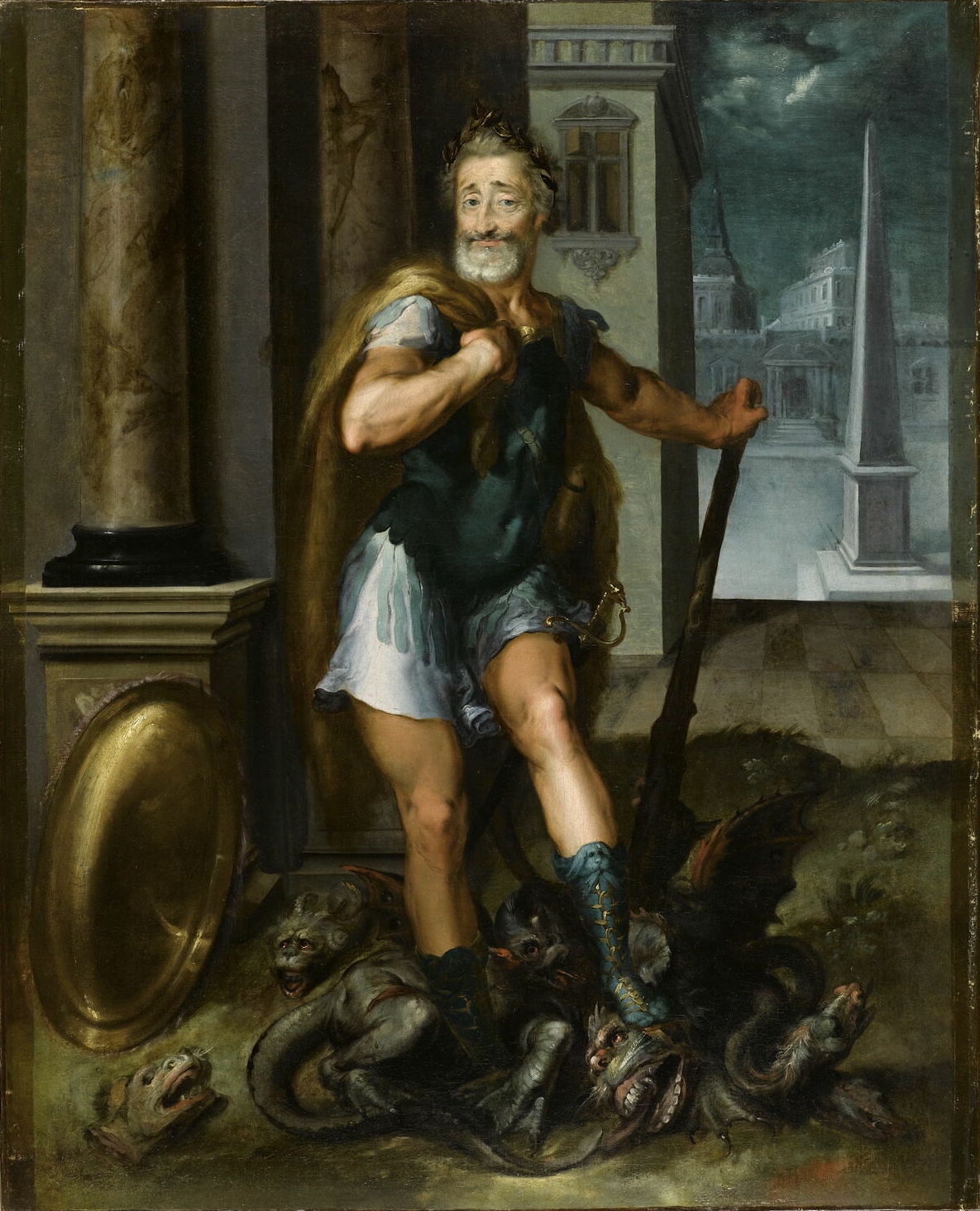
Today, the term “hydra” is often used to refer to an intractable problem that is not easily solved; as when Heracles attempted to slay the mythical Hydra, an attempt to find a solution results in new problems cropping up. King Henry IV of France chose to portray himself as Hercules (the Roman name for Heracles) standing over a vanquished Hydra after he brought an end to France’s internecine religious wars at the end of the sixteenth century. In the painting, Henry—sporting a rather self-satisfied facial expression—casually stands over the beheaded monster, representing his recent political enemy, the Catholic League.

Portrait of Henry IV as Hercules Slaying the Lernaean Hydra by Toussaint Dubreuil (1561–1600) (Public Domain)

Another more modern application of the ancient Hydra occurs in the field of biology: Hydra refers to the genus of fresh-water organisms (related to jellyfish) that have a tubular body featuring a mouth at one end surrounded by an array of tentacles. Like its mythological namesake, a Hydra can regenerate damaged tissue: when cut in half, each half can grow into a whole, complete Hydra. Similarly, like the Lernaean Hydra, these creatures may be quasi-immortal. The same biological factors that allow Hydra to regenerate tissue mean that they do not senesce, or grow old. 

Hydra attached to a substrate (© Creative Commons 
Attribution-Share Alike 3.0 Unported/Stephen Friedt)

The Hydra, with its symbolic and scientific iterations, illustrates how Greek and Roman myth continues to live on in new, often unexpected ways. Students may enjoy discussing other mythological figures that have taken on new meanings in the modern world. 

Still curious about how the ancients described the Hydra? In Ovid’s Metamorphoses (9.67–72) Hercules competes with the river god Achelous for Deianira’s hand in marriage. Taunting the god, he boasts about his victory over the Hydra, a feat that he claims was much more difficult than the one he is about to perform. Here, Hercules claims that the Hydra he vanquished had one-hundred heads!

“cunarum labor est angues superare mearum,”
dixit “et ut vincas alios, Acheloe, dracones,
pars quota Lernaeae serpens eris unus echidnae?
Vulneribus fecunda suis erat illa, nec ullum
de centum numero caput est inpune recisum,
quin gemino cervix herede valentior esset.
Hanc ego ramosam natis e caede colubris
crescentemque malo domui domitamque reclusi.”

“It was the pastime of my cradle days
to strangle better snakes than you—and though
your great length may excel all of your kind,
how small a part of that Lernaean snake
would you—one serpent be? It grew from wounds
I gave (at first it had one-hundred heads)
and every time I severed one head from
its neck two grew there in the place of one,
by which its strength increased. This creature then
outbranching with strong serpents, sprung from death
and thriving on destruction, I destroyed.”

Translation in Ovid’s Metamorphoses by Brookes Moore


–Amelia Wallace, Editor