Showing posts with label Ovid. Show all posts

Tuesday, February 11, 2020

Mythological Monster of the Month: Hydra


February’s Roman Calendar Feature

The 2019–2020 Roman Calendar features twelve mythical monsters from the 2019 edition of Martia Dementia, Bolchazy-Carducci’s annual spring bracket tournament. Visit us on social media (Facebook, Twitter, and our blog) for announcements regarding the 2020 Martia Dementia—starting later this month!

Behold, the Lernaean Hydra! According to Hesiod, this many-headed serpentine creature was the offspring of Typhon and Echidna, prolific parents of some of Greek mythology’s most famous monsters. An inhabitant of the liminal lake Lerna, the Hydra breathed out poisonous vapors that made the environs nearly impossible for mortals to even approach. Heracles, during his twelve labors, was tasked with slaying the Hydra—no easy feat, especially because as Heracles severed one Hydra head, two more grew in its place. Unable to defeat the Hydra on his own, Heracles asked his nephew Iolaus for help. While Heracles sliced away each head, Iolaus used a firebrand to cauterize the wounds, preventing the Hydra from regenerating.


Hydra, sixth-century bce Caeretan hydria (water vessel) 
(Digital image courtesy of the Getty’s Open Content Program)

A victorious Heracles dipped his arrows in the Hydra’s poisonous blood, creating a potent weapon that helped him accomplish several of his other labors—but would ultimately be his own downfall. The body of the Hydra was placed in the sky as the constellation Hydra, which has a shape resembling a twisting snake. This constellation is the largest of the eighty-eight modern constellations.

The Hydra depicted among eleven other constellations, 
nineteenth-century star chart card from a set known as Urania’s Mirror 
(Public Domain, restored by Adam Cuerden)

Today, the term “hydra” is often used to refer to an intractable problem that is not easily solved; as when Heracles attempted to slay the mythical Hydra, an attempt to find a solution results in new problems cropping up. King Henry IV of France chose to portray himself as Hercules (the Roman name for Heracles) standing over a vanquished Hydra after he brought an end to France’s internecine religious wars at the end of the sixteenth century. In the painting, Henry—sporting a rather self-satisfied facial expression—casually stands over the beheaded monster, representing his recent political enemy, the Catholic League.
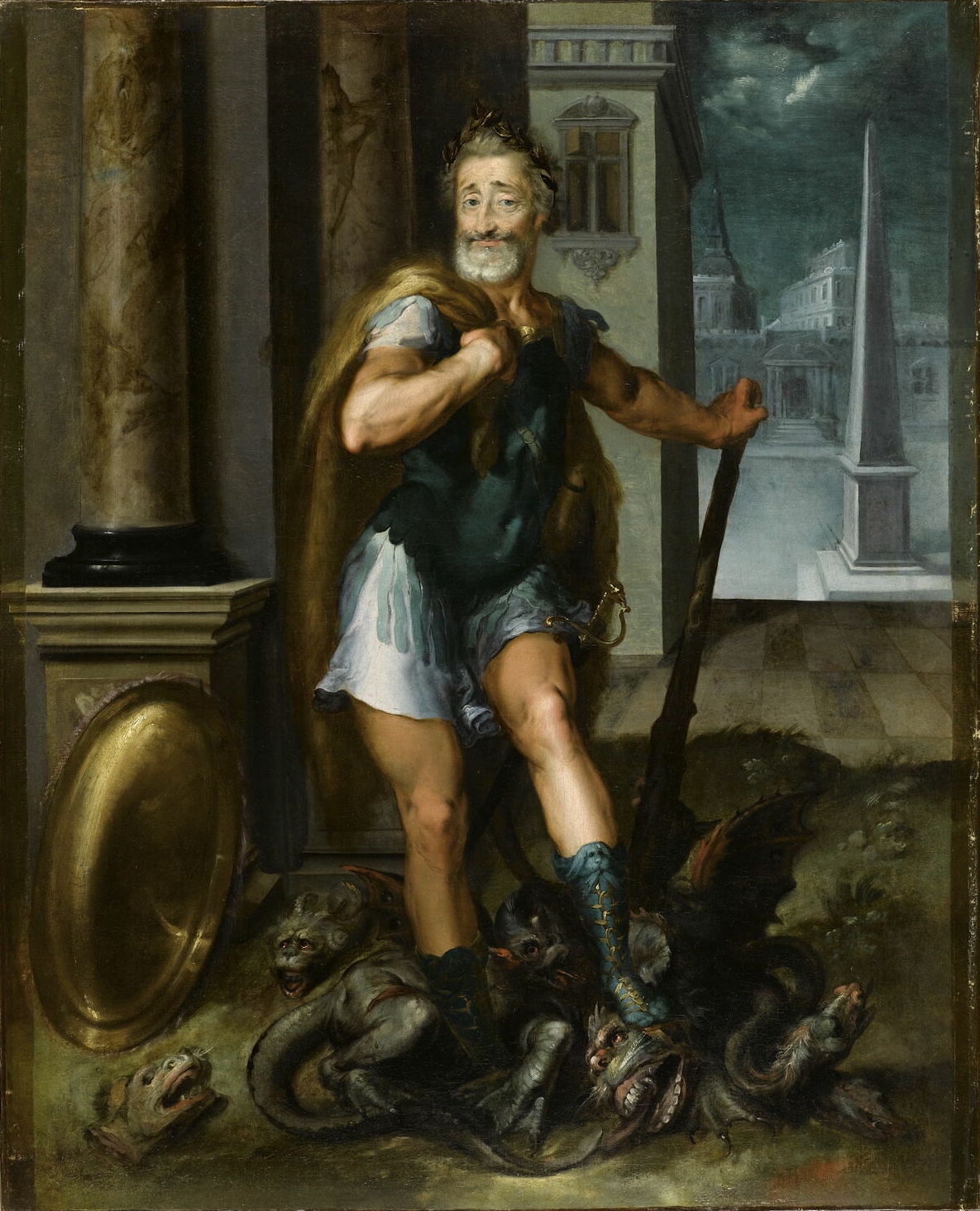
Portrait of Henry IV as Hercules Slaying the Lernaean Hydra by Toussaint Dubreuil (1561–1600) (Public Domain)

Another more modern application of the ancient Hydra occurs in the field of biology: Hydra refers to the genus of fresh-water organisms (related to jellyfish) that have a tubular body featuring a mouth at one end surrounded by an array of tentacles. Like its mythological namesake, a Hydra can regenerate damaged tissue: when cut in half, each half can grow into a whole, complete Hydra. Similarly, like the Lernaean Hydra, these creatures may be quasi-immortal. The same biological factors that allow Hydra to regenerate tissue mean that they do not senesce, or grow old. 

Hydra attached to a substrate (© Creative Commons 
Attribution-Share Alike 3.0 Unported/Stephen Friedt)

The Hydra, with its symbolic and scientific iterations, illustrates how Greek and Roman myth continues to live on in new, often unexpected ways. Students may enjoy discussing other mythological figures that have taken on new meanings in the modern world. 

Still curious about how the ancients described the Hydra? In Ovid’s Metamorphoses (9.67–72) Hercules competes with the river god Achelous for Deianira’s hand in marriage. Taunting the god, he boasts about his victory over the Hydra, a feat that he claims was much more difficult than the one he is about to perform. Here, Hercules claims that the Hydra he vanquished had one-hundred heads!

“cunarum labor est angues superare mearum,”
dixit “et ut vincas alios, Acheloe, dracones,
pars quota Lernaeae serpens eris unus echidnae?
Vulneribus fecunda suis erat illa, nec ullum
de centum numero caput est inpune recisum,
quin gemino cervix herede valentior esset.
Hanc ego ramosam natis e caede colubris
crescentemque malo domui domitamque reclusi.”

“It was the pastime of my cradle days
to strangle better snakes than you—and though
your great length may excel all of your kind,
how small a part of that Lernaean snake
would you—one serpent be? It grew from wounds
I gave (at first it had one-hundred heads)
and every time I severed one head from
its neck two grew there in the place of one,
by which its strength increased. This creature then
outbranching with strong serpents, sprung from death
and thriving on destruction, I destroyed.”

Translation in Ovid’s Metamorphoses by Brookes Moore


–Amelia Wallace, Editor

Wednesday, November 20, 2019

Mythological Monster of the Month: Cerberus


November’s Roman Calendar Feature

The 2019–2020 Roman Calendar features twelve mythical monsters from the 2019 edition of Martia Dementia, Bolchazy-Carducci’s annual spring bracket tournament. Visit us on social media (Facebook, Twitter, and our blog) for announcements regarding the 2020 Martia Dementia.


Cerberus, third-century BCE Sidonian Burial Caves 
(© Creative Commons Attribution-Share Alike 2.0 Generic/Ian Scott)

The infernal hound Cerberus is famous for his three heads, as in this third-century BCE tomb painting. The painting was found in the Sidonian Burial Caves in central Israel. These burial caves belonged to a family that originated in Sidon in what is now Lebanon.

Ancient sources differ in their depictions of Cerberus. The Greek poet Hesiod (ca. 750–650 BCE) describes Cerberus as having fifty heads (Theogony 306–12):

            τῇ δὲ Τυφάονά φασι μιγήμεναι ἐν φιλότητι

            δεινόν θ᾽ ὑβριστήν τ᾽ ἄνομόν θ᾽ ἑλικώπιδι κούρῃ:
            ἣ δ᾽ ὑποκυσαμένη τέκετο κρατερόφρονα τέκνα.
            Ὄρθον μὲν πρῶτον κύνα γείνατο Γηρυονῆι:
310      δεύτερον αὖτις ἔτικτεν ἀμήχανον, οὔ τι φατειὸν
            Κέρβερον ὠμηστήν, Ἀίδεω κύνα χαλκεόφωνον,
            πεντηκοντακέφαλον, ἀναιδέα τε κρατερόν τε:

            Men say that Typhaon the terrible, outrageous and lawless, was joined in love to her [Echidna], the maid with glancing eyes. So she conceived and brought forth fierce offspring; first she bore Orthus the hound of Geryones, [310] and then again she bore a second, a monster not to be overcome and that may not be described, Cerberus who eats raw flesh, the brazen-voiced hound of Hades, fifty-headed, relentless and strong.
translation in Hesiod, the Homeric Hymns, and Homerica by Hugh G. Evelyn-White

In Horace’s telling (Odes 2.13.33–36), the songs of the poets Alcaeus and Sappho transfix a hundred-headed Cerberus and other denizens of the Underworld:

            quid mirum, ubi illis carminibus stupens
            demittit atras belua centiceps
35        auris et intorti capillis
            Eumenidum recreantur angues?

            What marvel, when at those sweet airs
            The hundred-headed beast spell-bound
            Each black ear droops, and Furies' hairs
            Uncoil their serpents at the sound?
translation in Horace: The Odes and Carmen Saeculare of Horace by John Conington

Orpheus was also famous for enchanting Cerberus and other intimidating figures on his journey to the Underworld, as in Vergil’s rendition (Georgics 4.481–484):
            Quin ipsae stupuere domus atque intima Leti
            tartara caeruleosque implexae crinibus angues
            Eumenides, tenuitque inhians tria Cerberus ora
            atque Ixionii vento rota constitit orbis.

            Nay, even the deep Tartarean Halls of death
            Stood lost in wonderment, and the Eumenides [Furies],
            Their brows with livid locks of serpents twined;
            Even Cerberus held his triple jaws agape,
            And, the wind hushed, Ixion's wheel stood still.
translation in Bucolics, Aeneid, and Georgics Of Vergil by J. B. Greenough

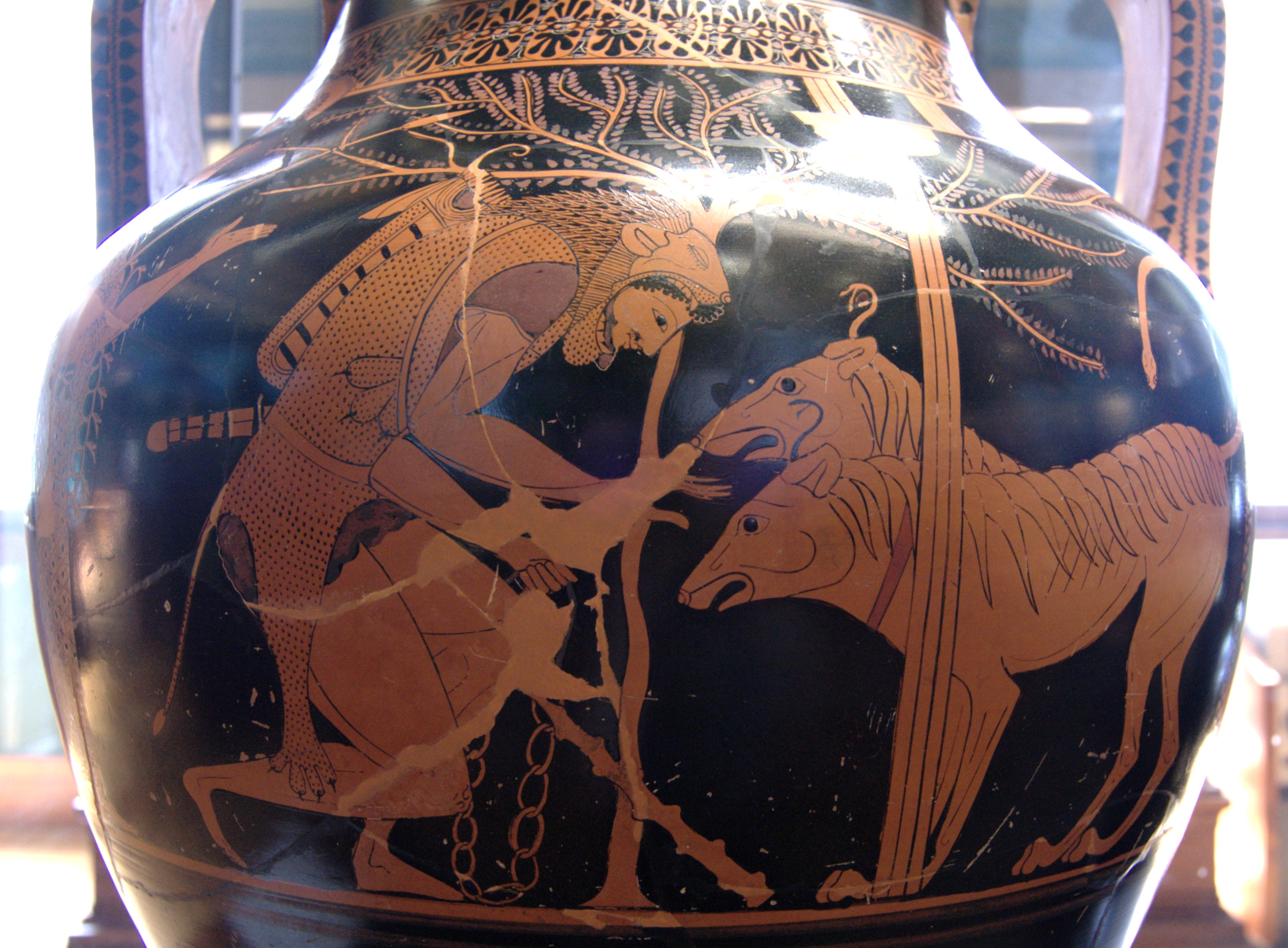
Hercules and Cerberus on a sixth-century BCE red-figure 
amphora now housed at the Louvre (Public Domain)
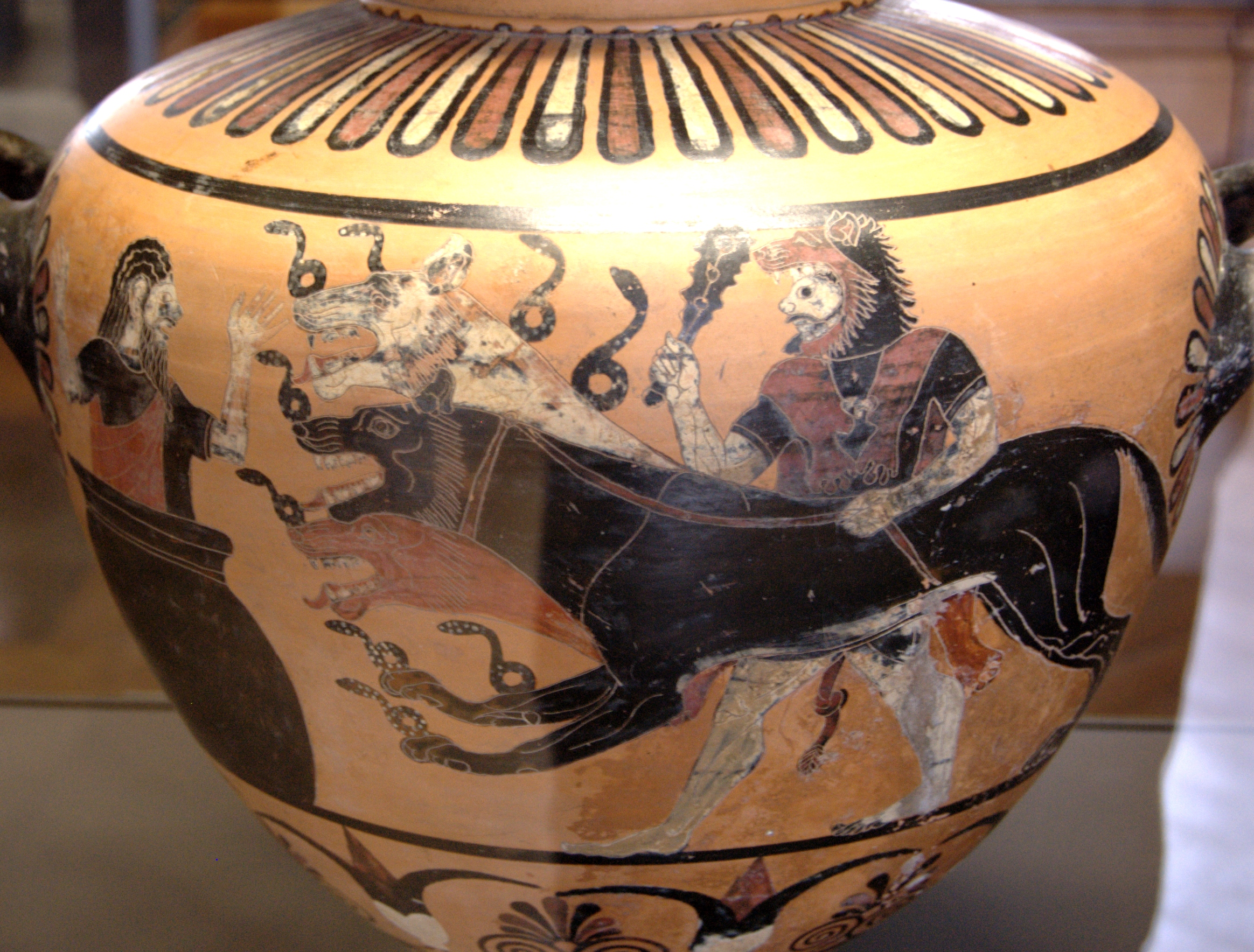
Cerberus is often discussed in association with the labors of Hercules, who was ordered to abduct the creature from the Underworld. Deianira, wife of Hercules, describes Cerberus in a catalog of Hercules’s labors (Ovid, Heroides 9.91–94):

            Prodigiumque triplex, armenti dives Hiberi
                 Geryones, quamvis in tribus unus erat;
            Inque canes totidem trunco digestus ab uno
                Cerberos inplicitis angue minante comis;

            You tell also of the heads that were fixed upon Thracian gates, and the mares fattened by the blood of men; of Geryon, that three-fold monster, rich in Iberian herds, who had three bodies in one; of Cerberus, forming three dogs from the same trunk, having his hair wreathed with hissing snakes . . .
translation in The Epistles of Ovid, translated into English prose . . .

Hercules presenting Cerberus to Eurystheus on a sixth-century BCE 
black-figure hydria, also at the Louvre (Public Domain)
Teachers may wish to ask students to discuss other depictions of Cerberus that they have encountered, and which written descriptions match them most closely.

—Laurel Draper, Editor

Wednesday, July 15, 2009

Id. Iul.

Nil homini certum est.
–Ovid

Wednesday, February 04, 2009

pridie Non. Feb.

Verba dat omnis amor.
–Ovid

Locus: Remedia Amoris 95

Friday, January 30, 2009

a.d. III Kal. Feb.

Saepe, premente deo, fert deus alter opem.
–Ovid

Locus: Tristia 1.2.4

Tuesday, January 27, 2009

a.d. V I Kal. Feb.

Saepe tacens vocem verbaque vultus habet.
–Ovid

Locus: Ars Amatoria 1.574

Tuesday, October 14, 2008

pridie Id. Oct.

Est quaedam flere voluptas.
–Ovid

Locus: Tristia 4.3.37

Tuesday, July 22, 2008

a.d. XI Kal. Aug.

Amans semper quod timet esse putat.
–Ovid

Locus: Ars Amatoria 3.720

Wednesday, June 25, 2008

a.d. VII Kal. Iul.

Crede mihi, bene qui latuit bene vixit, et intra fortunam debet quisque manere suam.
–Ovid

Locus: Tristia 3.4.25–26

Friday, June 13, 2008

Id. Iun.

Tot mala sum passus quot in aethere sidera lucent.
–Ovid

Locus: Tristia 1.5.47

Monday, June 02, 2008

a.d. IV Non. Iun.

Dum loquor, hora fugit.
–Ovid

Locus: Amores 1.11.15

Tuesday, May 13, 2008

a.d. III Id. Mai.

Exitus acta probat.
–Ovid

Locus: Heroides 2.85

Tuesday, February 26, 2008

a.d. V Kal. Mar.

Ut fragilis glacies, interit ira mora.
–Ovid

Locus: Ars Amatoria 1.374

Wednesday, January 30, 2008

a.d. III Kal. Feb.

Quaerit aquas in aquis.
–Ovid

Locus: Amores 2.2.43

Wednesday, November 14, 2007

a.d. XVIII Kal. Dec.

Est quaedam flere voluptas.
–Ovid

Locus: Tristia 4.3.37

Friday, September 28, 2007

a.d. IV Kal. Oct.

Lacrimae pondera vocis habent.
–Ovid

Locus: Heroides 3.4

Monday, July 30, 2007

a.d. III Kal. Aug.

Aequore quot pisces, fronde teguntur aves, quot caelum stellas, tot habet tua Roma puellas.
–Ovid

Locus: Ars Amatoria 1.58–59

Tuesday, May 15, 2007

Id. Mai.

Nil homini certum est.
–Ovid

Locus: P. Ovidius Naso, Tristia, 5.5.27