Showing posts with label Latin pedagogy. Show all posts

Thursday, March 05, 2020

3 Martia Dementia In-Class Activities (+ Free Printables and More!)


In Martia Dementia 2020, the mythological monsters have returned—all thirty-two of them! If you'd like some materials to use with your students to provide background information on these ancient figures, look no further. Bolchazy-Carducci has created blog posts addressing the artistic, literary, and historical significance of six of these creatures. These posts are an excellent starting point for completing research or acquiring basic knowledge. We are also providing very short summaries of the mythological figures, all contained within a printable PDF. Find the links to these resources below.

Need some ideas for covering this year's Martia Dementia field in class? One simple, quick activity for ensuring a basic familiarity is the game Two Truths and a Lie. Simply print out the mythological monster biography sheet linked below. Cut the sheet into strips so that you can individually assign each figure to a student (or a group of students). After learning a little about their assigned figure, each student then presents two truths and one lie about the monster to the class, which has to guess which is fact and which is fiction.

For a more complex activity, ask students to use the Bolchazy-Carducci materials as a starting point to complete additional research on an assigned monster. Using what they have learned, they then craft a persuasive presentation on why their monster should win all of Martia Dementia. After students have sufficiently debated each figure's merits, they can then vote on which figure "deserves" to win. (In fact, this activity can be used to determine a full-class bracket, though you may want to also incorporate the ancient military leaders into this activity; we will be posting biographies for these figures as well at the bottom of the page.)

Looking for other ideas? This year, we are also pleased to provide some free printables and online activities: we have created all of the pieces for a mythological monster Guess Who?–inspired game, Quis Est? If you have the boards at hand, all you will need to do is print out two sets of small cards to insert in the boards and one set of larger cards. We have also provided colorful backings reminiscent of the color scheme of the original game—print these on the back of your cards if you'd really like to have that 1980s-feel. (If you want a simpler set-up, we can confirm that simply printing the small cards on regular paper and then slipping the paper in front of the game's original cardboard pieces works as well.) Regular Guess Who? rules apply, but with this unusual cast of characters, game play is quite challenging. Students will need to know a lot about these monsters to be able to ask incisive questions (and then, understand the answers and accurately flip down the incorrect monsters). To assist with game play, we are also providing a worksheet that students can complete to assess their knowledge.

As an added bonus, we have a short online activity that students can play to practice what they have learned about the mythological monsters before or after playing Quis Est? This activity, which we are making freely accessible, is built on our Lumina platform. Note that the crossword puzzle is replayable: merely hit "re-start," and a new configuration (with varying sets of words) becomes available. Click here or see the link below to play these online games.

Do you use any class or Latin club activities that incorporate Martia Dementia? Let us know in the comments!

Monster of the Month Blog Posts


Printable Materials


Thursday, January 09, 2020

Mythological Monster of the Month: Griffin


January’s Roman Calendar Feature
The 2019–2020 Roman Calendar features twelve mythical monsters from the 2019 edition of Martia Dementia, Bolchazy-Carducci’s annual spring bracket tournament. Visit us on social media (Facebook, Twitter, and our blog) for announcements regarding the 2020 Martia Dementia.

January’s monster of the month is the majestic griffin, which according to legend had the body of a lion and the head and wings of an eagle. The January image in the 2020 Roman Calendar shows a detail of a griffin taken from a fourth-century BCE tomb painting found in Paestum, Italy. In the full fresco, two griffins—note the leonine hindquarters and tail, massive feathered wings, and curved beaks—attack a panther, poised to pounce.

Two griffins and a panther, Lucanian fresco in the Museo Archeologico Nazionale
(© Creative Commons Attribution-Share Alike 3.0 Unported/Sailko)
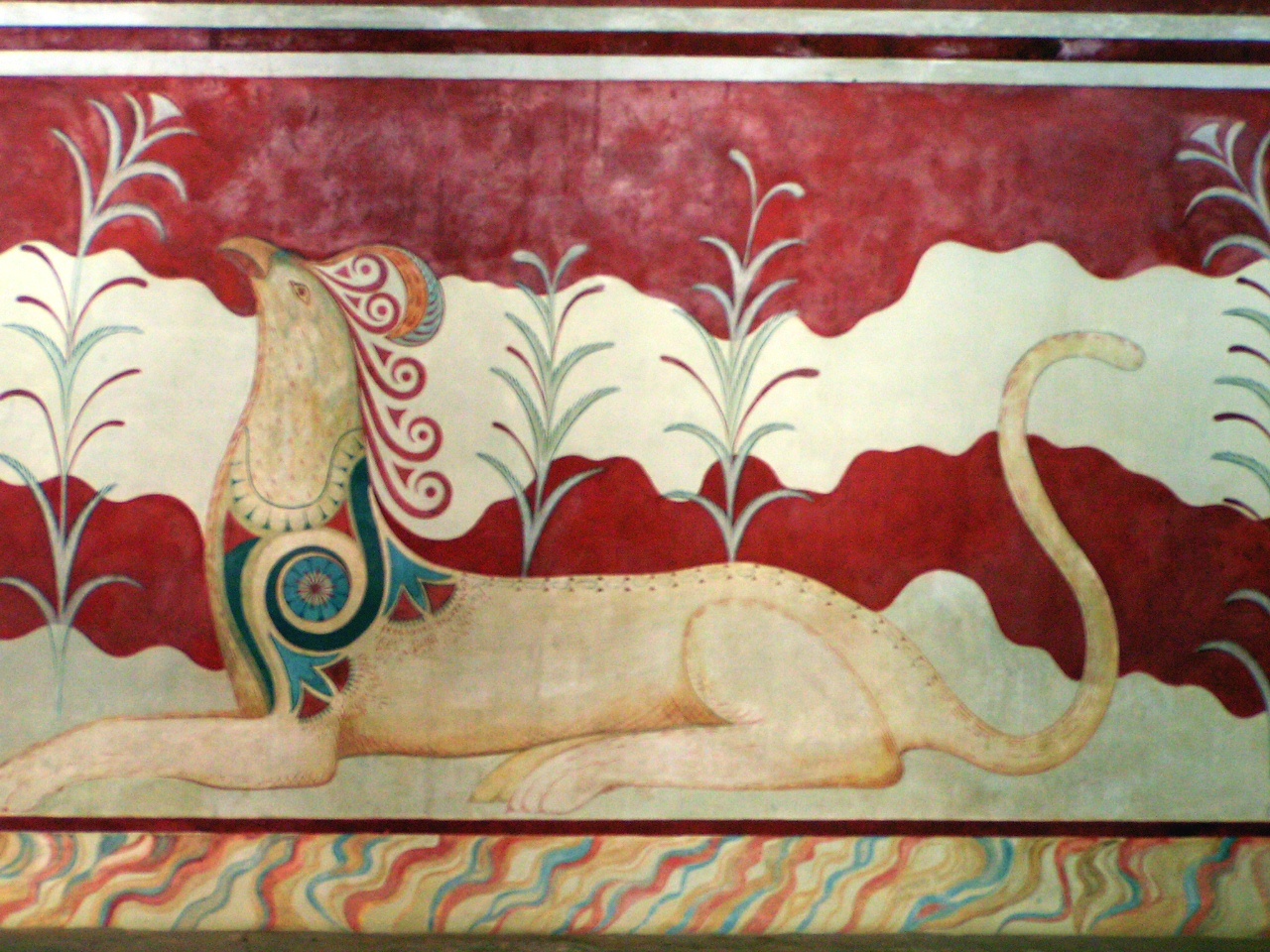
The griffin’s mythical origins lie in the ancient near east and Egypt, with depictions of the creature first appearing around 3,000 BCE. By the fifteenth century BCE, griffin imagery had made its way to the Greek world: the hybrid beast was vibrantly portrayed in a fresco found in the “Throne Room” in the Palace of Knossos on Crete. The griffin remained a popular artistic motif in much of the ancient Mediterranean world, and its prominence continued into the medieval era, when the griffin became a common symbol in heraldry. Griffins were not only used in medieval Christian art, but also in Islamic art of the same time period. The Pisa Griffin, a massive bronze sculpture created in eleventh-century Al-Andalus (modern-day Spain), incorporates Arabic text and patterns associated with textile designs.

 Griffin fresco in the “Throne Room,” Palace of Knossos, Crete
(© Creative Commons Attribution-Share Alike 3.0 Unported/Paginazero)

The Pisa Griffin, an eleventh-century bronze now in the Pisa Cathedral, was originally
 a fountain spout (© Creative Commons Attribution-Share Alike 3.0 Unported/Memorato)

While there are few early written accounts of the griffin, several Greek and Roman writers described griffins as the guardians of gold deposits located in Anatolia, Central Asia, or India. Various authors, including Pliny the Elder (see excerpt below), have detailed the enmity between the griffins and the Arimaspians, a neighboring tribe of one-eyed men who perpetually tried to steal the griffins’ gold. These legends of the griffin continued into the middle ages, and griffins were frequently featured in medieval bestiaries. The griffin still captures the imagination of writers today: the griffin makes an appearance in The Sons of Neptune by Rick Riordan. In the Harry Potter series by J.K. Rowling, Harry and his friends are sorted into the Hogwarts house of Gryffindor, a name that evokes the bravery, strength—and even the ferocity—of the mythical griffin. The hippogriff, a related creature that is half-lion, half-horse, plays an important role in Rowling’s Harry Potter and the Prisoner of Azkaban.

When discussing with students, ask where else they have seen the griffin. Answers may include other stories or literature, as well as architectural motifs, coats of arms, and logos.

Pliny’s Account

In the passage excerpted below from Natural History 7.10, Pliny describes the battles between the Arimaspians and the monstrous griffins, citing Herodotus and Aristeas of Proconnesus as his sources:
 
sed iuxta eos, qui sunt ad septentrionem versi, haut procul ab ipso aquilonis exortu specuque eius dicto, quem locum Gesclithron appellant, produntur Arimaspi, quos diximus, uno oculo in fronte media insignes. quibus adsidue bellum esse circa metalla cum Grypis, ferarum volucri genere, quale vulgo traditur, eruente ex cuniculis aurum, mira cupiditate et feris custodientibus et Arimaspis rapientibus, multi, sed maxime inlustres Herodotus et Aristeas Proconnesius scribunt.
In the vicinity also of those who dwell in the northern regions, and not far from the spot from which the north wind arises, and the place which is called its cave, and is known by the name of Geskleithron, the Arimaspians are said to exist, whom I have previously mentioned, a nation remarkable for having but one eye, and that placed in the middle of the forehead. This race is said to carry on a perpetual warfare with the Griffins, a kind of monster, with wings, as they are commonly represented, for the gold which they dig out of the mines, and which these wild beasts retain and keep watch over with a singular degree of cupidity, while the Arimaspians are equally desirous to get possession of it. Many authors have stated to this effect, among the most illustrious of whom are Herodotus and Aristeas of Proconnesus.
translation in The Natural History of Pliny the Elder by John Bostock


—Amelia Wallace, Editor


Wednesday, December 04, 2019

Mythological Monster of the Month: Chimera


December’s Roman Calendar Feature

The 2019–2020 Roman Calendar features twelve mythical monsters from the 2019 edition of Martia Dementia, Bolchazy-Carducci’s annual spring bracket tournament. Visit us on social media (Facebook, Twitter, and our blog) for announcements regarding the 2020 Martia Dementia.

This month’s creature is the Chimera, a deadly beast composed of parts of other animals. Descriptions of the Chimera vary, but it is often described as having the head of a lion, the tail of a snake, and extending from its back the head of a goat. The term “chimera” has come to mean figuratively something illusory, or a hybrid animal or other organism.


Chimera by Pintoricchio (Bernardino di Betto, 1454–1513)
(© Creative Commons Attribution-Share Alike 3.0 Unported/Sailko)
 As noted in September’s feature on Argus, Pintoricchio (1454–1513), whose name means “little painter” in Italian, was a Renaissance painter known for his frescoes. Though his real name was Bernardino di Betto, he acquired the nickname Pintoricchio due to his short stature. This image is taken from the Ceiling of the Demigods in the Palazzo dei Penitenzieri in Rome. The ceiling features 63 mythological figures.


Bellerophon killing the Chimera (fourth-century BCE Roman mosaic)
(Public Domain)

This Roman mosaic, now in the collection of the Archaeological Museum of Rhodes, features the hero Bellerophon astride Pegasus as he kills the Chimera. Homer describes the monster thus (Iliad 6.180–183):

180      ... ἣ δ᾽ ἄρ᾽ ἔην θεῖον γένος οὐδ᾽ ἀνθρώπων,
            πρόσθε λέων, ὄπιθεν δὲ δράκων, μέσση δὲ χίμαιρα,
            δεινὸν ἀποπνείουσα πυρὸς μένος αἰθομένοιο,
            καὶ τὴν μὲν κατέπεφνε θεῶν τεράεσσι πιθήσας.

She was of divine stock, not of men, in the fore part a lion, in the hinder a serpent, and in the midst a goat, breathing forth in terrible wise the might of blazing fire. And Bellerophon slew her, trusting in the signs of the gods.
translation in Homer: The Iliad with an English Translation by A. T. Murray


The Chimera of Arezzo (ca. 400 BCE) (© Creative Commons 2.0/Carole Raddato)

The Chimera of Arezzo, located in the Museo Archeologico Nazionale, Florence, is a famous Etruscan bronze sculpture that corresponds to Homer’s description of the Chimera. It may have belonged to a sculpture group depicting Bellerophon slaying the Chimera.
                                                    
The Epicurean philosopher Lucretius (a favorite of B-C founder Lou Bolchazy) includes the Chimera in a list of mythological monsters whose supposed attributes make their existence impossible (De Rerum Natura 5.901–6):

            flamma quidem vero cum corpora fulva leonum
            tam soleat torrere atque urere quam genus omne
            visceris in terris quod cumque et sanguinis extet,
            qui fieri potuit, triplici cum corpore ut una,
905      prima leo, postrema draco, media ipsa, Chimaera
            ore foras acrem flaret de corpore flammam?

And how could there be the chimaera—a creature that has three different bodies combined in one (a lion up front, a goat in the middle, and a snake behind) and breathes hot flames from its belly—since any animal that is made up of flesh and blood, including the yellow lion, will be consumed by fire?
translation in Lucretius: The Nature of the Universe by G. B. Cobbold

The Chimera presents several opportunities for classroom discussion in Latin:
  • Introduce or review the Latin terms for animals and body parts. Ask students to draw and label the body parts of animals, or provide pictures. Depending on the level of the class, the teacher may supply a word bank or ask students to list the words that they remember in groups or as a class.
  •  Describe the Chimera as a picture talk, or begin with a drawing dictation after review of some key vocabulary. Narration can be quite simple: “Pingite monstrum, quod habet tria corpora. Prima pars monstri est leo ferocissimus! Id est, hoc monstrum habet caput leonis. . . .” After students have drawn their monsters, they can share their drawings in pairs and point out the different body parts and components (tantum Latine). Then, the teacher can reveal the different artistic representations, and students can compare with their drawings of the Chimera.
  • Preview or review the genitive of possession. As appropriate for the class, provide the genitive forms of various animals and remind students of the genitive endings of each declension.

—Laurel Draper, Editor

Wednesday, November 20, 2019

Mythological Monster of the Month: Cerberus


November’s Roman Calendar Feature

The 2019–2020 Roman Calendar features twelve mythical monsters from the 2019 edition of Martia Dementia, Bolchazy-Carducci’s annual spring bracket tournament. Visit us on social media (Facebook, Twitter, and our blog) for announcements regarding the 2020 Martia Dementia.


Cerberus, third-century BCE Sidonian Burial Caves 
(© Creative Commons Attribution-Share Alike 2.0 Generic/Ian Scott)

The infernal hound Cerberus is famous for his three heads, as in this third-century BCE tomb painting. The painting was found in the Sidonian Burial Caves in central Israel. These burial caves belonged to a family that originated in Sidon in what is now Lebanon.

Ancient sources differ in their depictions of Cerberus. The Greek poet Hesiod (ca. 750–650 BCE) describes Cerberus as having fifty heads (Theogony 306–12):

            τῇ δὲ Τυφάονά φασι μιγήμεναι ἐν φιλότητι

            δεινόν θ᾽ ὑβριστήν τ᾽ ἄνομόν θ᾽ ἑλικώπιδι κούρῃ:
            ἣ δ᾽ ὑποκυσαμένη τέκετο κρατερόφρονα τέκνα.
            Ὄρθον μὲν πρῶτον κύνα γείνατο Γηρυονῆι:
310      δεύτερον αὖτις ἔτικτεν ἀμήχανον, οὔ τι φατειὸν
            Κέρβερον ὠμηστήν, Ἀίδεω κύνα χαλκεόφωνον,
            πεντηκοντακέφαλον, ἀναιδέα τε κρατερόν τε:

            Men say that Typhaon the terrible, outrageous and lawless, was joined in love to her [Echidna], the maid with glancing eyes. So she conceived and brought forth fierce offspring; first she bore Orthus the hound of Geryones, [310] and then again she bore a second, a monster not to be overcome and that may not be described, Cerberus who eats raw flesh, the brazen-voiced hound of Hades, fifty-headed, relentless and strong.
translation in Hesiod, the Homeric Hymns, and Homerica by Hugh G. Evelyn-White

In Horace’s telling (Odes 2.13.33–36), the songs of the poets Alcaeus and Sappho transfix a hundred-headed Cerberus and other denizens of the Underworld:

            quid mirum, ubi illis carminibus stupens
            demittit atras belua centiceps
35        auris et intorti capillis
            Eumenidum recreantur angues?

            What marvel, when at those sweet airs
            The hundred-headed beast spell-bound
            Each black ear droops, and Furies' hairs
            Uncoil their serpents at the sound?
translation in Horace: The Odes and Carmen Saeculare of Horace by John Conington

Orpheus was also famous for enchanting Cerberus and other intimidating figures on his journey to the Underworld, as in Vergil’s rendition (Georgics 4.481–484):
            Quin ipsae stupuere domus atque intima Leti
            tartara caeruleosque implexae crinibus angues
            Eumenides, tenuitque inhians tria Cerberus ora
            atque Ixionii vento rota constitit orbis.

            Nay, even the deep Tartarean Halls of death
            Stood lost in wonderment, and the Eumenides [Furies],
            Their brows with livid locks of serpents twined;
            Even Cerberus held his triple jaws agape,
            And, the wind hushed, Ixion's wheel stood still.
translation in Bucolics, Aeneid, and Georgics Of Vergil by J. B. Greenough

Hercules and Cerberus on a sixth-century BCE red-figure 
amphora now housed at the Louvre (Public Domain)
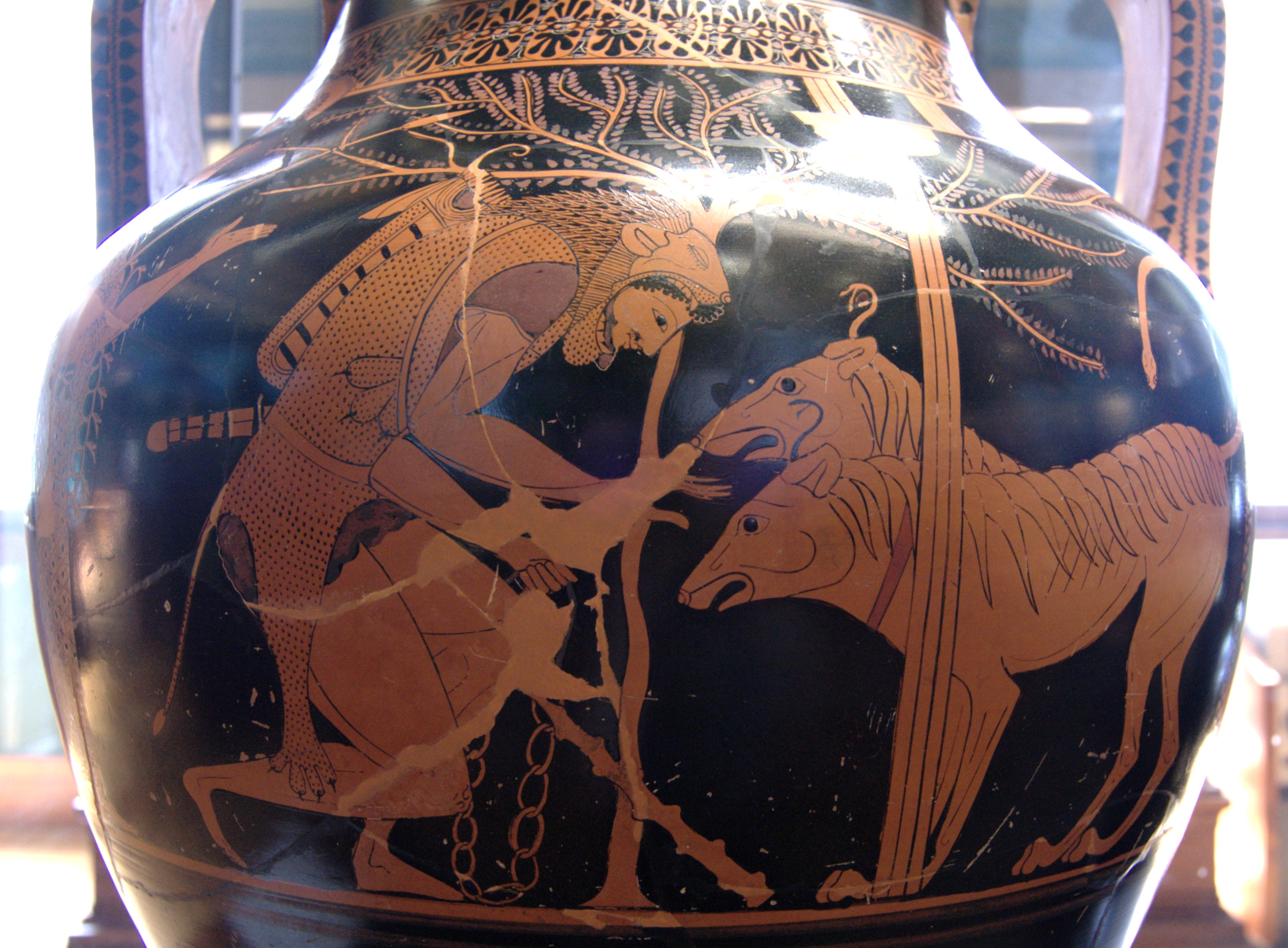
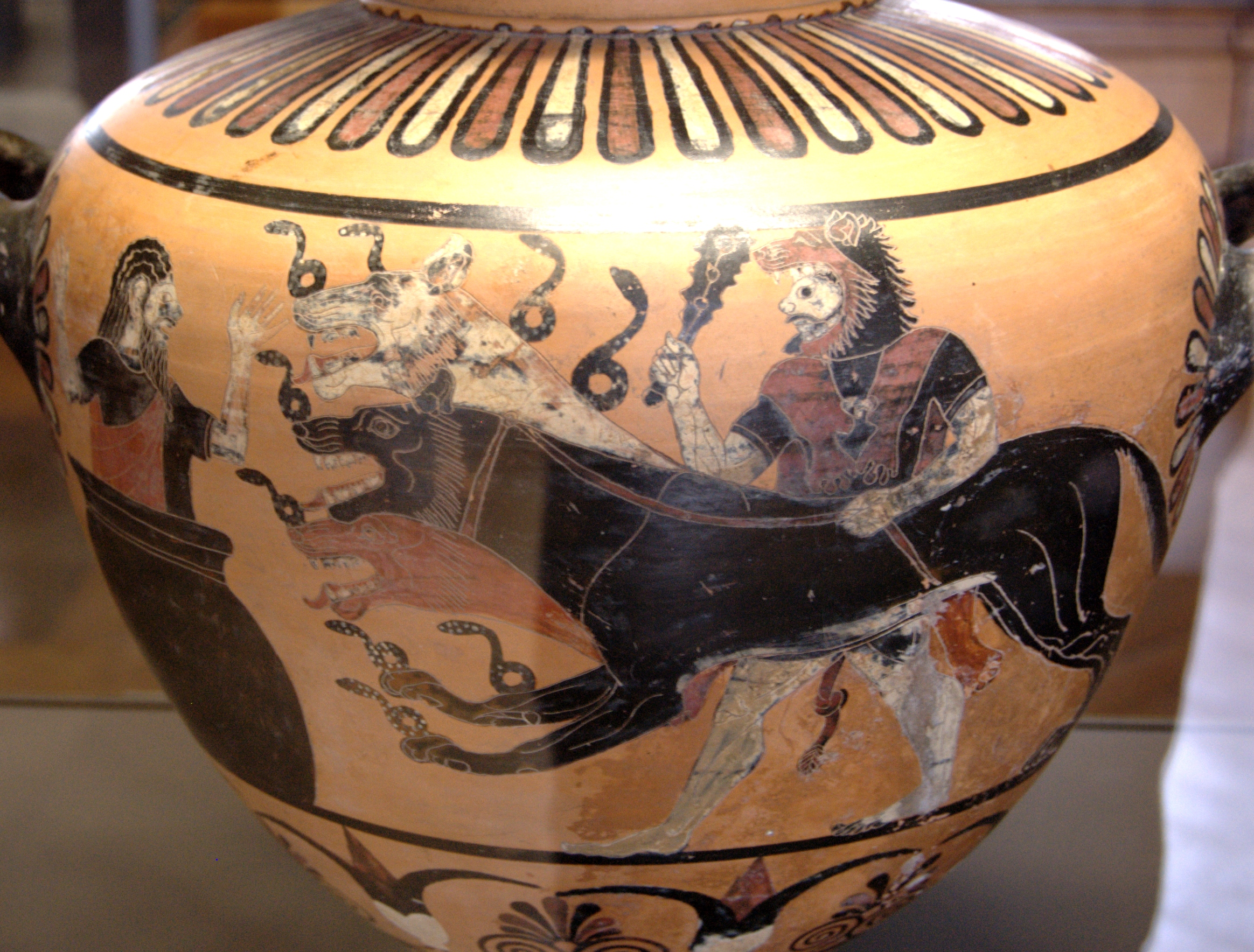
Cerberus is often discussed in association with the labors of Hercules, who was ordered to abduct the creature from the Underworld. Deianira, wife of Hercules, describes Cerberus in a catalog of Hercules’s labors (Ovid, Heroides 9.91–94):

            Prodigiumque triplex, armenti dives Hiberi
                 Geryones, quamvis in tribus unus erat;
            Inque canes totidem trunco digestus ab uno
                Cerberos inplicitis angue minante comis;

            You tell also of the heads that were fixed upon Thracian gates, and the mares fattened by the blood of men; of Geryon, that three-fold monster, rich in Iberian herds, who had three bodies in one; of Cerberus, forming three dogs from the same trunk, having his hair wreathed with hissing snakes . . .
translation in The Epistles of Ovid, translated into English prose . . .

Hercules presenting Cerberus to Eurystheus on a sixth-century BCE 
black-figure hydria, also at the Louvre (Public Domain)
Teachers may wish to ask students to discuss other depictions of Cerberus that they have encountered, and which written descriptions match them most closely.

—Laurel Draper, Editor

Tuesday, October 08, 2019

Mythological Monster of the Month: Manticore


October’s Roman Calendar Feature

The 2019–2020 Roman Calendar features twelve mythical monsters from the 2019 edition of Martia Dementia, Bolchazy-Carducci’s annual spring bracket tournament. Visit us on social media (Facebook, Twitter, and our blog) for announcements regarding the 2020 Martia Dementia.

Manticore, thirteenth-century CE manuscript (Digital image courtesy of the Getty’s Open Content Program)
The manticore is a mythical leonine creature with the body of a lion, the head of a human, and a tail resembling either that of a scorpion or the quills of a porcupine. Tales of the manticore originated in Persia (where it was known as the martikhoras) and spread to Greece (called μαρτιχόρας martichoras or μαντιχώρας mantichoras) and Italy (adapted into Latin as mantichora).

Medieval authors often included manticores in bestiaries, following the description in Pliny the Elder’s Historia Naturalis. The Roman Calendar’s October image accompanies a Latin description of manticores found in the Northumberland Bestiary, a mid-thirteenth-century work produced in England.

Teachers may wish to ask students to name additional mythological or fictional creatures that are composites of real animals.

Manticore chasing a man, ca. ninth–tenth century CE sculpted sandstone monument, Meigle Museum 
Pliny the Elder (23–79 CE) describes the manticore in his Historia Naturalis (8.34 in the Latin edition; 8.30 in the English edition):
Apud eosdem nasci Ctesias scribit quam mantichoran appellat, triplici dentium ordine pectinatim coeuntium, facie et auriculis hominis, oculis glaucis, colore sanguineo, corpore leonis, cauda scorpionis modo spicula infigentem, vocis ut si misceatur fistulae et tubae concentus, velocitatis magnae, humani corporis vel praecipue adpetentem.

Latin text from the edition of Karl Friedrich Theodor Mayhoff (1906) available at Perseus
Ctesias informs us, that among these same Æthiopians, there is an animal found, which he calls the mantichora [manticore]; it has a triple row of teeth, which fit into each other like those of a comb, the face and ears of a man, and azure eyes, is of the colour of blood, has the body of the lion, and a tail ending in a sting, like that of the scorpion. Its voice resembles the union of the sound of the flute and the trumpet; it is of excessive swiftness, and is particularly fond of human flesh.

translation by John Bostock (1855) available at Perseus
A manticore featured on the album cover of Pictures at an Exhibition by the rock band Emerson, Lake & Palmer (1971)
Although the works of Ctesias (late fifth century BCE) are now fragmentary, his description in Indica of the manticore is summarized by Photios I of Constantinople (ca. 810–893 CE) in his Bibliotheke (57.7):
Καὶ περὶ τοῦ μαρτιχόρα τοῦ ἐν αὐτοῖς ὄντος θηρίου, ὡς τὸ πρόσωπον ἐοικὼς ἀνθρώπῳ μέγεθος μέν ἐστιν ὥσπερ λέων, καὶ χρόαν ἐρυθὸς ὡς κιννάβαρι· τρίστιχοι δὲ ὀδόντες· ὦτα δὲ ὥσπερ ἀνθρώπου, καὶ ὀφθαλμοὺς γλαυκοὺς ὁμοίους ἀνθρώπῳ· τὴν δὲ κέρκον ἔχει οἵανπερ σκορπίος ὁ ἠπειρώτης, ἐν ᾗ καὶ τὸ κέντρον ἔχει, μείζω ὑπάρχουσαν πήχεος. ἔχει δὲ καὶ ἐκ πλαγίου τῆς κέρκου ἔνθα καὶ ἔνθα κέντρα· ἔχει δὲ καὶ ἐπ’ ἄκρῳ ὥσπερ σκορπίος, κέντρον. καὶ τούτῳ μὲν, ἐὰν προσέλθῃ τὶς, κεντεῖ τῷ κέντρῳ, καὶ πάντως ὁ κεντηθεὶς ἀποθνήσκει· ἐὰν δέ τις πόῤῥωθεν μάχηται πρὸς αὐτὸν, καὶ ἔμπροσθεν ἱστὰς τὴν οὐρὰν ὥσπερ ἀπὸ τόξου βάλλει τοῖς κέντροις, καὶ ὄπισθεν ἐπ’ εὐθείας ἀποτείνων. βάλλει δὲ ὅσον πλέθρον εἰς μῆκος· καὶ πάντας οὓς ἂν βάλῃ πάντως ἀποκτείνει, πλὴν ἐλέφαντος. τὰ δὲ κέντρα αὐτοῦ ἐστι τὸ μὲν μῆκος ὅσον ποδιαῖα, τὸ δὲ πλάτος ὅσον σχοῖνος λεπτότατος. μαρτιχόρα δὲ Ἑλληνιστὶ ἀνθρωποφάγον, ὅτι πλεῖστα ἐσθίει ἀναιρῶν ἀνθρώπους· ἐσθίει δὲ καὶ τὰ ἄλλα ζῷα. μάχεται δὲ καὶ τοῖς ὄνυξι καὶ τοῖς κέντροις. τὰ δὲ κέντρα πάλιν φησὶν, ἐπειδὰν ἐκτοξευθῇ, ἀναφύεσθαι. ἔστι δὲ πολλὰ ἐν τῇ Ἰνδικῇ. ἀποκτείνουσι δὲ αὐτὰ τοῖς ἐλέφασιν ἐποχούμενοι ἄνθρωποι, κἀκεῖθεν βάλλοντες. 
He describes an animal called the martikhora, found in India. Its face is like a man’s—it is about as big as a lion, and in colour red like cinnabar. It has three rows of teeth—ears like the human—eyes of a pale-blue like the human and a tail like that of the land scorpion, armed with a sting and more than a cubit long. It has besides stings on each side of its tail, and, like the scorpion, is armed with an additional sting on the crown of its head, wherewith it stings any one who goes near it, the wound in all cases proving mortal. If attacked from a distance it defends itself both in front and in rear—in front with its tail, by up-lifting it and darting out the stings, like shafts shot from a bow, and in rear by straightening it out. It can strike to the distance of a hundred feet, and no creature can survive the wound it inflicts save only the elephant. The stings are about a foot in length, and not thicker than the finest thread. The name martikhora means in Greek ἀνθρωποφάγος (i.e. man-eater), and it is so called because it carries off men and devours them, though it no doubt preys upon other animals as well. In fighting it uses not only its stings but also its claws. Fresh stings grow up to replace those shot away in fighting. These animals are numerous in India, and are killed by the natives who hunt them with elephants, from the backs of which they attack them with darts.

translation in Ancient India as Described by Ktêsias the Knidian (1882) by J. W. McCrindle

—Laurel Draper, Editor

Wednesday, September 18, 2019

Mythological Monster of the Month: Argus


September’s Roman Calendar Feature

The 2019–2020 Roman Calendar features twelve mythical monsters from the 2019 edition of Martia Dementia, Bolchazy-Carducci’s annual spring bracket tournament. Visit us on social media (Facebook, Twitter, and our blog) for announcements regarding the 2020 Martia Dementia.

Argus by Pintoricchio (Bernardino di Betto, 1454–1513) (Public Domain)
September’s Roman Calendar image highlights Argus, sometimes called Panoptes (Greek for “all-seeing”), famous for his hundred eyes. Argus is perhaps best known for his role in the story of Io, a young woman turned into a heifer because of Jupiter’s lust for her. Some sources say that Jupiter transformed Io in an effort to hide her from Juno, while others say that Juno transformed her as punishment. Regardless, Juno charged Argus with watching over Io in the form of the heifer to prevent Jupiter from visiting her again. Jupiter then sent Mercury to slay Argus and free Io.

Pintoricchio (1454–1513), whose name means “little painter” in Italian, was a Renaissance painter known for his frescoes. Though his real name was Bernardino di Betto, he acquired the nickname Pintoricchio due to his short stature. This fresco appears in the Room of the Saints in the Vatican’s Borgia Apartment. The room takes its name from large frescoes depicting seven Christian saints. Smaller frescoes of scenes from Egyptian and classical mythology feature bulls (or, in Io’s case, a heifer) in reference to Pope Alexander VI (1431–1503), whose heraldic emblem was a bull. Please note that for the calendar, the border of the image (including Io) was cropped to better display Argus’s features.

Sixth-century bce Greek vase depicting Argus and Io (Public Domain)
Depictions of Argus don’t always feature extra eyes, as in this sixth-century bce Greek black-figure vase. Found in Italy, it is now in the collection of the Staatliche Antikensammlungen in Munich, Germany.

Teachers may wish to ask students to compare and contrast the images above with Ovid’s description below, using the Latin or English texts as appropriate for the class.

Ovid describes Argus in his Metamorphoses (1.622–629)


Latin (text and notes from A. G. Lee’s Ovid: Metamorphoses Book I)

paelice donata non protinus exuit omnem
diva metum, timuitque Iovem et fuit anxia furti
donec Arestoridae servandam tradidit Argo.
centum luminibus cinctum caput Argus habebat;         625
inde suis vicibus capiebant bina quietem,
cetera servabant atque in statione manebant.
constiterat quocumque modo, spectabat ad Io;
ante oculos Io, quamvis aversus, habebat.
(p. 62)

622
exuit: cf. Am. 3, 4, 43-4: 'vultusque severos / exue', Cic. Att. 13, 2, 1: 'humanitatem omnem exuimus'.

623
-que: 'but'; cf. 15 n.
furti: cf. 606 n.

624
Arestoridae: the only occurrence of this patronymic in Latin poetry. Arestor was a shadowy Argive hero.

625
centum . . . cinctum: for the similarity of sound cf. 489: 'vetat votoque', 633: 'toro terrae', 739: 'fitque quod ante fuit'.

626
inde: 'of these'; cf. Plaut. Mil. 711: 'dant in de partem mihi', Met.13,829: 'lac mihi semper adest niveum: pars inde bibenda / servatur . . . ' The French en derives from this word.
suis vicibus: 'in their turn', cf. 4, 218: 'noxque vicem peragit', 'night takes her turn, completes her round'.

627
servabant: the word is used absolutely as in 684, cf. Pl. Most. 451: 'nemo in aedibus servat'; it is prob. from the military vocabulary. serva is frequent in the comedians in the sense of 'look out, take care', cf. Gk. φυλάττου.
in statione: 'on duty, at their post'; another military phrase. Cf. Caes. B.C. 1, 43 : 'quae in statione pro castris erant Afranii cohortes'; Cic. Sen. 73: 'de praesidia et statione vitae decedere'.

628-9
Ovidian repetition to drive the point home.      
(p. 133)

English

Juno regardful of Jove's cunning art,
lest he might change her to her human form,
gave the unhappy heifer to the charge
of Argus, Aristorides, whose head                               
was circled with a hundred glowing eyes;
of which but two did slumber in their turn
whilst all the others kept on watch and guard.

translation by Brookes More (1922) available at Perseus


—Laurel Draper, Editor

Tuesday, September 03, 2019

5 Reasons to Learn Latin with Lumina: Artes Latinae

What makes Lumina: Artes Latinae the best choice for learning (or reviewing) Latin on your own, at your own pace? Artes Latinae features a comprehensive scope and sequence that gives students all the tools they need to master Latin.


1. Artes Latinae is a time-tested, award-winning Latin program that uses a variety of strategies to empower students as they learn Latin.

Artes Latinae, the self-teaching Latin program designed by Dr. Waldo Sweet, has been helping students succeed in their Latin-learning endeavors for nearly sixty years. The innovative program employs a structural approach to language, incorporating research about the deep inner workings of Latin in order to help students more confidently tackle distinctive elements of Latin syntax. At the same time, Artes Latinae makes use of a wide variety of teaching techniques to facilitate internalizing the vocabulary and grammar of Latin. Many of these strategies remain remarkably relevant to today’s students and adhere to key principles of second language acquisition theories. Artes Latinae is now offered as an online interactive program via Lumina: Artes Latinae, giving students even more flexibility in learning Latin.

2. Artes Latinae employs innovative and effective Latin pedagogy.

Notably, Artes Latinae treats Latin as a language that was (and continues to be) spoken aloud, not just written and read. Students routinely listen to Latin recordings of individual words, traditional sayings and maxims, and questions; in turn, students respond to prompts orally and can check their answers against model audio. Furthermore, Artes Latinae offers the option of three pronunciation styles: American Scholastic (the default pronunciation), Restored Classical (an attempt to reconstruct how Latin would have been spoken c. 100 bce–100 ce), and Ecclesiastical.

With an emphasis on an “active Latin” learning process, Artes Latinae employs methods that require students to think in Latin without using English as an intermediary. When introducing new vocabulary, the program relies on images, Latin synonyms and antonyms, and eventually, more involved Latin definitions. Use of Latin questioning techniques (today, commonly referred to as “circling”) ensures that students receive repeated input of new vocabulary and target forms, while also gently leading students to a fuller understanding of ancient and medieval Latin sayings (and later, longer poems). 

3. Artes Latinae’s programmed learning design helps students learn how to learn.

In its use of active Latin methodologies, Artes Latinae always provides extensive scaffolding for students. On a micro level, this program repeatedly scaffolds new pieces of information. In each unit as students answer questions in Latin, they are first asked to echo questions and responses based on the model recordings. They then respond to similar questions with only one word in Latin, before finally giving longer responses based on the original models. Students at last transform models through substitution and transformation. Another such technique involves beginning with short “kernel” sentences and gradually adding modifiers to create a much more complex thought (what is sometimes called amplificatio, or expansion).

Similarly, the structure of the program as a whole is firmly rooted in principles of scaffolding. In early units of the program, English is frequently used to introduce words, concepts, and grammatical terms. But as students progress, Artes Latinae begins to slowly fade out English explanations, replacing them with Latin words and phrases. By the end of the first course, students have even begun to use Latin grammar terms to describe morphology and syntax!

Additionally, the program begins with explicit instruction on how to approach and study new material, asking students to think about techniques that they personally find helpful (i.e., helping build metacognition). Artes Latinae then gradually “vanishes” some of the help once provided. For example, when first introducing students to Latin sentences, Artes Latinae breaks down the structure of each sentence word-by-word, giving explanations about how to think about and interpret Latin sentences. This sort of explicit instruction fades away, although the program continues to remind students to think about previously learned principles and study methods.

4. Artes Latinae features rich and varied content from classical, medieval, and Renaissance Latin. 

The content of Artes Latinae offers students immense benefit. In particular, the program introduces authentic ancient and medieval Latin from the beginning, using such sentences as models for students to get a sense of Latin’s structure. While Artes Latinae draws from many of the “greats” (e.g., Cicero, Horace, Ovid), the course also makes clear the rich and varied history of Latin literature: using excerpts from the Latin Vulgate, for example, and comparing Renaissance-era epigrams with those of Martial.

Another emphasis of Artes Latinae is word building, both in Latin and in English. English derivatives are always introduced alongside Latin vocabulary. But perhaps more importantly, the course frequently breaks down Latin words into prefixes, roots, and suffixes and shows how new words can be made from these building blocks. As students encounter these key elements of Latin words, they also learn how they changed as they came into English. For instance, as students encounter the word avaritia in Latin, they learn that the –tia suffix is used to turn adjectives (in this case, avarus) into abstract nouns. Likewise, they learn that –tia became the suffix –ice in English (here, avarice).

5. The Lumina platform for Artes Latinae offers extensive student support.

In addition to providing students supportive scaffolding, Artes Latinae ensures that students receive immediate feedback as they go frame by frame. Moreover, Bolchazy-Carducci is proud to offer Artes users several options for obtaining additional Latin support as needed. On the Lumina site, users can access a general discussion forum to chat with others using Artes Latinae. A Q&A forum invites students to ask questions of a Bolchazy Latin instructor, who will regularly respond to queries. As B-C expands and builds on Lumina: Artes Latinae, we anticipate adding more options for students to receive individualized support.