Showing posts with label Vergil. Show all posts

Monday, February 17, 2025

Martia Dementia 2025

As February comes to a close and the Kalends of March approach, a time-honored tradition looms on the horizon: Martia Dementia! Every March, Bolchazy-Carducci sets a number of matches between ancient figures and allows them to play out until one victor (or victrix) emerges. This year, monuments of the Mediterranean (and beyond) will return from the 2024 bracket to compete against “people” of the announced AP® Latin syllabus. These "people" include figures from the Vergil and Pliny texts as well as figures from and the authors of the suggested companion "teacher choice" selections. Whether ancient authors, epic heroes, poetic personae, epistolary addressees, or in one case, a volcano, these literary personalities will prove worthy foes for the likes of the Colosseum and the Hanging Gardens of Babylon. 


To the victor—whoever finishes with the best bracket—belong the spoils. Before getting to the prizes, here is how the competition will work. Please read through the process carefully. 


The Bracket

Starting today, complete and submit a bracket to be eligible for wondrous prizes. Please access and submit your bracket online via the following link: Martia Dementia 2025 Bracket. (Update: due to popular demand, we have also provided a printable bracket for reference.)


When you access the online Martia Dementia bracket, click the “Submit your bracket!” button to start making your selections. You will be prompted to enter your name and email address; we need this information so that we can track and notify the winners of the competition once Martia Dementia is completed. After signing up, you will be asked to predict a winner for each game in the bracket. 


At the bottom of this post, you will find a link to a PDF showing short descriptions of each of this year’s Martia Dementia participants. You can access the same descriptions by clicking on the photo of a given figure in the bracket.


Once you have completed all of your selections and have submitted your bracket, you will receive a notice thanking you for your submission.


If you would like to view your prediction bracket, simply click on the link to “View My Prediction.” We recommend saving a copy of your bracket at this point so that you can keep track of how you are doing as the competition progresses. With our online submission system, you can also easily share your prediction bracket via email or social media—a great way to show off how you’re doing, or earn some pity points if your bracket is going poorly. 


Brackets will be accepted through Wednesday, March 19.


The Survey

A voting survey will be made available on Thursday, March 20, where you can vote for your picks. Whichever figures have the most votes by the time the survey closes will advance through the round. Actively participating in the survey betters your chances at winning. We will announce via social media when voting for each round has opened.

 
We cannot stress enough the importance of voting. When the survey goes live, cast your votes! Get your friends to vote for your picks. Teachers, get your students to stuff the survey with favorable votes!


Victori Spolia

This competition is not solely for bringing glory to your favorite ancient writer or bird. Bolchazy-Carducci Publishers is offering book prizes for the brackets that most closely resemble the final results; a $100 book credit will be awarded to the first-place participant, a $50 credit to the second-place participant, and a $25 credit to the third-place participant. Feeling like you no longer stand a chance? Do not give up! There will also be a $25 credit for having the most abysmal bracket! 


Stay Connected

Be sure to bookmark this post and check back here to access the link to the voting bracket. Also, follow us on Facebook for updates as the competition progresses.


Remember, brackets close March 19, and the first round of voting will begin March 20.


Bracket and Other Resources

Access the online bracket

Access a printable bracket (for reference only)

Access a description of all Martia Dementia 2025 figures


Voting Schedule:

·       Round 1: March 20–21

·       Round 2: March 22–25

·       Round 3 (Sweet 16): March 27–28

·       Quarterfinals (Elite 8): March 29–April 1

·       Semifinals (Final 4): April 2–4

·       Final (Championship): April 7–9


Note that each round of voting will open at 7:30 a.m. central time and close at 4:00 p.m. central time on the designated days. 


Advanced Placement® and AP® are trademarks registered and/or owned by the College Board, which was not involved in the production of, and does not endorse, this product.


Wednesday, November 20, 2019

Mythological Monster of the Month: Cerberus


November’s Roman Calendar Feature

The 2019–2020 Roman Calendar features twelve mythical monsters from the 2019 edition of Martia Dementia, Bolchazy-Carducci’s annual spring bracket tournament. Visit us on social media (Facebook, Twitter, and our blog) for announcements regarding the 2020 Martia Dementia.


Cerberus, third-century BCE Sidonian Burial Caves 
(© Creative Commons Attribution-Share Alike 2.0 Generic/Ian Scott)

The infernal hound Cerberus is famous for his three heads, as in this third-century BCE tomb painting. The painting was found in the Sidonian Burial Caves in central Israel. These burial caves belonged to a family that originated in Sidon in what is now Lebanon.

Ancient sources differ in their depictions of Cerberus. The Greek poet Hesiod (ca. 750–650 BCE) describes Cerberus as having fifty heads (Theogony 306–12):

            τῇ δὲ Τυφάονά φασι μιγήμεναι ἐν φιλότητι

            δεινόν θ᾽ ὑβριστήν τ᾽ ἄνομόν θ᾽ ἑλικώπιδι κούρῃ:
            ἣ δ᾽ ὑποκυσαμένη τέκετο κρατερόφρονα τέκνα.
            Ὄρθον μὲν πρῶτον κύνα γείνατο Γηρυονῆι:
310      δεύτερον αὖτις ἔτικτεν ἀμήχανον, οὔ τι φατειὸν
            Κέρβερον ὠμηστήν, Ἀίδεω κύνα χαλκεόφωνον,
            πεντηκοντακέφαλον, ἀναιδέα τε κρατερόν τε:

            Men say that Typhaon the terrible, outrageous and lawless, was joined in love to her [Echidna], the maid with glancing eyes. So she conceived and brought forth fierce offspring; first she bore Orthus the hound of Geryones, [310] and then again she bore a second, a monster not to be overcome and that may not be described, Cerberus who eats raw flesh, the brazen-voiced hound of Hades, fifty-headed, relentless and strong.
translation in Hesiod, the Homeric Hymns, and Homerica by Hugh G. Evelyn-White

In Horace’s telling (Odes 2.13.33–36), the songs of the poets Alcaeus and Sappho transfix a hundred-headed Cerberus and other denizens of the Underworld:

            quid mirum, ubi illis carminibus stupens
            demittit atras belua centiceps
35        auris et intorti capillis
            Eumenidum recreantur angues?

            What marvel, when at those sweet airs
            The hundred-headed beast spell-bound
            Each black ear droops, and Furies' hairs
            Uncoil their serpents at the sound?
translation in Horace: The Odes and Carmen Saeculare of Horace by John Conington

Orpheus was also famous for enchanting Cerberus and other intimidating figures on his journey to the Underworld, as in Vergil’s rendition (Georgics 4.481–484):
            Quin ipsae stupuere domus atque intima Leti
            tartara caeruleosque implexae crinibus angues
            Eumenides, tenuitque inhians tria Cerberus ora
            atque Ixionii vento rota constitit orbis.

            Nay, even the deep Tartarean Halls of death
            Stood lost in wonderment, and the Eumenides [Furies],
            Their brows with livid locks of serpents twined;
            Even Cerberus held his triple jaws agape,
            And, the wind hushed, Ixion's wheel stood still.
translation in Bucolics, Aeneid, and Georgics Of Vergil by J. B. Greenough

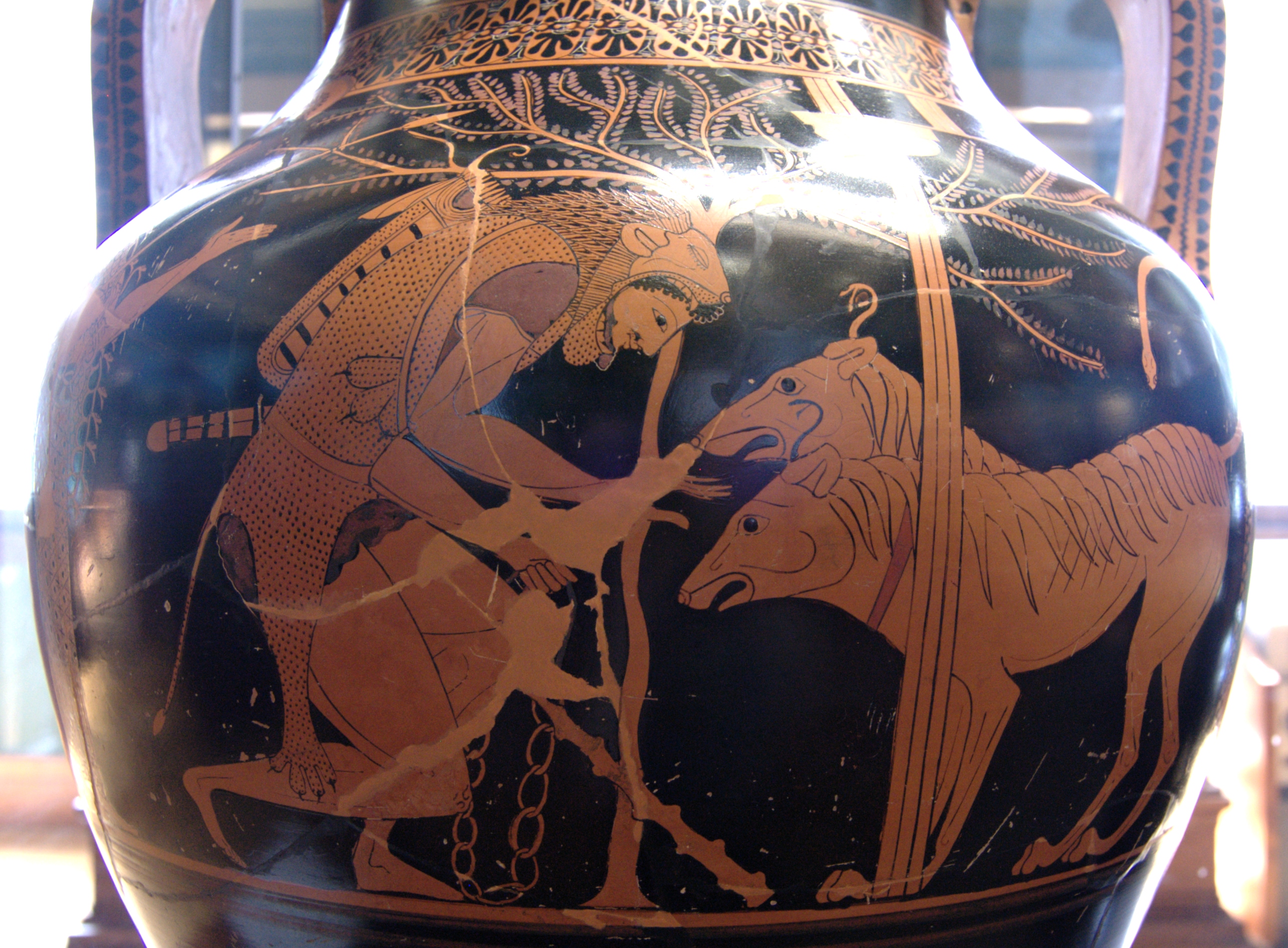
Hercules and Cerberus on a sixth-century BCE red-figure 
amphora now housed at the Louvre (Public Domain)
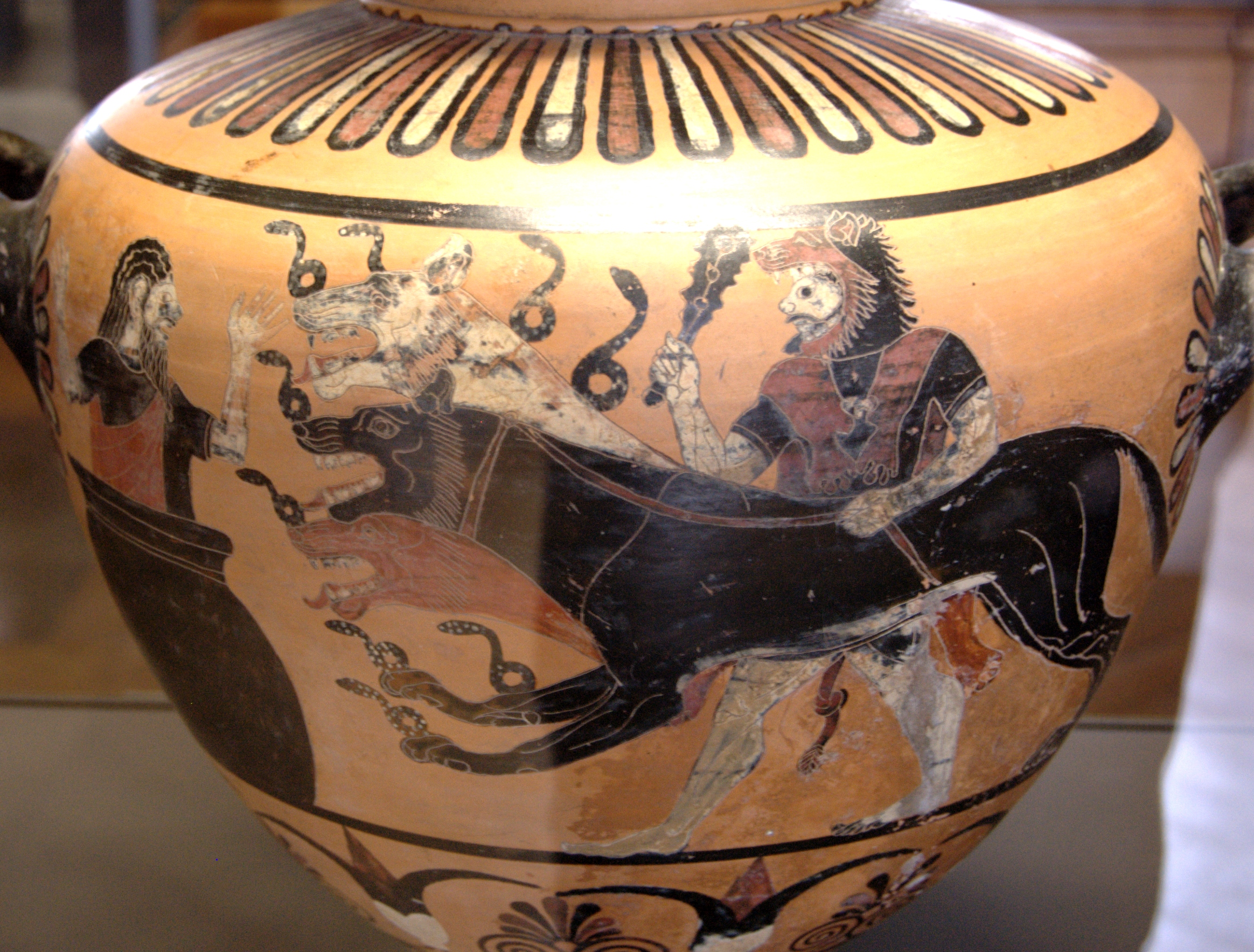
Cerberus is often discussed in association with the labors of Hercules, who was ordered to abduct the creature from the Underworld. Deianira, wife of Hercules, describes Cerberus in a catalog of Hercules’s labors (Ovid, Heroides 9.91–94):

            Prodigiumque triplex, armenti dives Hiberi
                 Geryones, quamvis in tribus unus erat;
            Inque canes totidem trunco digestus ab uno
                Cerberos inplicitis angue minante comis;

            You tell also of the heads that were fixed upon Thracian gates, and the mares fattened by the blood of men; of Geryon, that three-fold monster, rich in Iberian herds, who had three bodies in one; of Cerberus, forming three dogs from the same trunk, having his hair wreathed with hissing snakes . . .
translation in The Epistles of Ovid, translated into English prose . . .

Hercules presenting Cerberus to Eurystheus on a sixth-century BCE 
black-figure hydria, also at the Louvre (Public Domain)
Teachers may wish to ask students to discuss other depictions of Cerberus that they have encountered, and which written descriptions match them most closely.

—Laurel Draper, Editor

Friday, August 16, 2013

bolchazy.com has a new look and more!!!

bolchazy.com New Look
As part of our ongoing efforts to offer the best customer experience possible, Bolchazy-Carducci Publishers is happy to announce that our new website is LIVE. The new site has many upgrades including a new, streamlined shopping cart and better navigability.
 
We hope you enjoy exploring the new site. Keep your eyes open for a video tour of the new features. Please be aware that, if you have ordered online from us before, the new shopping cart will require you to change your password. If you are a new online customer, you will need to create a login before placing your first order.

and More!!!
Two more webinars have been added to our 2013 Fall Webinar Schedule. Bolchazy-Carducci Publishers is offering SIX informative webinars this fall including a
Special Triad of Webinars on “Helping Students Make Connections”. These three webinars
developed by creative veterans of the Latin classroom, present a laddered approach to teaching students to look for, recognize, and appreciate the role of connections in Latin literature. Two Latin for the New Millennium webinars are scheduled and one webinar by author Ronnie Ancona on Teaching “Uncensored” Catullus. 

Great webinar line-up sure to be informative and engaging to join us register on line.

Friday, January 16, 2009

a.d. XVII Kal. Feb.

Tu ne cede malis.
-Vergil

Locus: Aeneid 6.95

Tuesday, January 13, 2009

Id. Ian.

Furor arma ministrat.
–Vergil

Locus: Aeneid 1.150

Wednesday, December 24, 2008

a.d. IX Kal. Ian.

Labor omnia vincit.
–Vergil

Locus: Georgics 1.145

Wednesday, October 15, 2008

Id. Oct.

Vergil's birthday!

It's been a long time since 70 BC, but we're still reading his works.