Showing posts with label Mythology. Show all posts

Wednesday, September 11, 2024

In Need of Some Online Latin Resources? Bolchazy-Carducci Is Here to Help!

Bolchazy-Carducci Publishers has made a variety of Latin-language resources available online on our Distance Learning webpage! Many of these resources are free for teachers to download and use in their classrooms, such as the beginning, intermediate, and advanced Latin activity packets. There are also a number of short Latin stories, which retell ancient myths, legends, and historical tales in language appropriate for beginning learners. Designed to correspond to specific chapters and reviews in Latin for the New Millennium, Level 1, these stories, written by Emma Vanderpool, can be used in any Latin classroom. Be sure to look out for updates posted to our Distance Learning webpage!

Read about Cloelia and Lars Porsenna here,
then complete the Lumina comprehension exercises.

Vanderpool’s Latin stories have also been embedded within Lumina for LNM. Lumina for LNM is an online interactive program that accompanies the first two levels of the Latin for the New Millennium textbook series. Available only to Lumina users, special comprehension activities have also been created for the supplementary readings. Like all Lumina practice, these new activities are self-grading and give automatic feedback so that students can assess their own progress immediately after completing a lesson. Want to learn more about Lumina? Be sure to try out the exercises keyed to the story Cloelia et Lars Porsenna at the following link.

Have fun with mythological monsters with this free Lumina activity. 

If you like what you see and want to learn more about Lumina, send an email to lumina@bolchazy.com to set up a live demonstration of the platform. This short video overview shows the layout and functionality of Lumina for LNM. And, if you are looking for a fun, quick enrichment activity for a Latin class, be sure to try out this mythological monster activity.


Tuesday, February 20, 2024

Martia Dementia 2024


Bolchazy-Carducci is now completing its first DECADE of Martia Dementia contests. All sorts of ancient figures, from authors and emperors to gods, monsters, and even birds have entered our gladiatorial arena. Now, monuments of the Mediterranean (and a few farther flung places) are about to strive for a place as Martia Dementia champions! The returning competitors: the non-Olympian deities that battled mightily in 2023, only to succumb to triple-headed Cerberus!

To the victor—whoever finishes with the best bracket—belong the spoils. Before getting to the prizes, here is how the competition will work. Please read through the process carefully. For reference, we are providing a PDF of the bracket that you can use with your classes, but be sure to submit your final choices via the online system.

The Bracket

Starting today, complete and submit a bracket to be eligible for wondrous prizes. Please access and submit your bracket online via the following link: Martia Dementia 2024 Bracket. 

When you access the online Martia Dementia bracket, click the “Submit your bracket!” button to start making your selections. You will be prompted to enter your name and email address; we need this information so that we can track and notify the winners of the competition once Martia Dementia is completed. After signing up, you will be asked to predict a winner for each game in the bracket. 


At the bottom of this post, you will find a link to a PDF showing short descriptions of each of this year’s
Martia Dementia participants. You can access the same descriptions by clicking on the photo of a given figure in the bracket.


Once you have completed all of your selections and have submitted your bracket, you will receive a notice thanking you for your submission.

If you would like to view your prediction bracket, simply click on the link to “View My Prediction.” We recommend saving a copy of your bracket at this point so that you can keep track of how you are doing as the competition progresses. With our online submission system, you can also easily share your prediction bracket via email or social media—a great way to show off how you’re doing, or earn some pity points if your bracket is going poorly. 

We are also providing a PDF copy of the bracket here (for reference only) in case you would like to print a copy of the bracket and fill one in with your class. However, we are not accepting scanned brackets, so make sure that you also submit the bracket online.

Brackets will be accepted through Wednesday, March 20.

The Survey

A voting survey will be made available on Thursday, March 21, where you can vote for your picks. Whichever figures have the most votes by the time the survey closes will advance through the round. Actively participating in the survey betters your chances at winning. We will announce via social media when voting for each round has opened.

We cannot stress enough the importance of voting. When the survey goes live, cast your votes! Get your friends to vote for your picks. Teachers, get your students to stuff the survey with favorable votes!

Victori Spolia

This competition is not solely for bringing glory to your favorite ancient writer or bird. Bolchazy-Carducci Publishers is offering book prizes for the brackets that most closely resemble the final results; a $100 book credit will be awarded to the first-place participant, a $50 credit to the second-place participant, and a $25 credit to the third-place participant. Feeling like you no longer stand a chance? Do not give up! There will also be a $25 credit for having the most abysmal bracket! 

Stay Connected

Be sure to bookmark this post for future reference. Also, follow us on Facebook for updates as the competition progresses.

Remember, brackets close March 20, and the first round of voting will begin March 21.     

Bracket and Other Resources

Voting Schedule

  • Round 1: March 21–22
  • Round 2: March 23–26
  • Round 3 (Sweet 16): March 28–29
  • Quarterfinals (Elite 8): March 30–April 2
  • Semifinals (Final 4): April 3–5
  • Final (Championship): April 6–9
Note that each round of voting will open at 7:30 a.m. central time and close at 4:00 p.m. central time on the designated days.  

Tuesday, February 14, 2023

Martia Dementia 2023


After eight years of spring campaigns—in which gods, monsters, birds, authors, and military commanders struggled on the
Martia Dementia battle field—we’re back, with the ninth annual contest! Last year, some bloodthirsty birds defeated a slew of ancient authors, with the poisonous ducks of Pontus gaining victory over Rome’s sacred chickens. In 2023, mythical monsters are back, and ready to take on a new set of rivals, gods and goddesses. In keeping with the theme of the 2022–2023 Roman Calendar, these Martia Dementia competitors represent the non-Olympians, those deities that might personify important concepts, inspire daily worship, or offer divine revelation through initiation into their mysteries.

See the downloadable, printable PDF of the Roman Calendar here, showcasing artwork and imagery associated with twelve of this year’s Martia Dementia participants. For a variety of mythical monster activities, scroll to the bottom of our Distance Learning page to find an online matching game, printable templates to create a Guess Who?–style board game, and more.

To the victor—whoever finishes with the best bracket—belong the spoils. Before getting to the prizes, here is how the competition will work. Please read through the process carefully. For reference, we are providing a PDF of the bracket that you can use with your classes, but be sure to submit your final choices via the online system.

The Bracket

Starting today, complete and submit a bracket to be eligible for wondrous prizes. Please access and submit your bracket online via the following link: Martia Dementia 2023 Bracket. You can also find the bracket at the bottom of this blog post.

When you access the online Martia Dementia bracket, click the “Submit your bracket!” button to start making your selections. You will be prompted to enter your name and email address; we need this information so that we can track and notify the winners of the competition once Martia Dementia is completed. After signing up, you will be asked to predict a winner for each game in the bracket.  

For each round, you view a set of contestants that will "face off" against one another. Predict and select your winner for each "contest" in the bracket. 

At the bottom of this post, you will find a link to a PDF showing short descriptions of each of this year’s Martia Dementia participants. You can access the same descriptions by clicking on the photo of a given figure in the bracket.

Clicking on a god or monster will bring up a short description.

Once you have completed all of your selections and have submitted your bracket, you will receive a notice thanking you for your submission. If you would like to view your prediction bracket, simply click on the link to “View My Prediction.” We recommend saving a copy of your bracket at this point so that you can keep track of how you are doing as the competition progresses. With our online submission system, you can also easily share your prediction bracket via email or social media—a great way to show off how you’re doing, or earn some pity points if your bracket is going poorly. 

We are also providing a PDF copy of the bracket here (for reference only) in case you would like to print a copy of the bracket and fill one in with your class. However, we are not accepting scanned brackets, so make sure that you also submit the bracket online.

Brackets will be accepted through Wednesday, March 15 (the Ides of March!).

The Survey

A voting survey will be made available on Thursday, March 16, where you can vote for your picks. Whichever figures have the most votes by the time the survey closes will advance through the round. Actively participating in the survey betters your chances at winning. We will announce via social media when voting for each round has opened.

We cannot stress enough the importance of voting. When the survey goes live, cast your votes! Get your friends to vote for your picks. Teachers, get your students to stuff the survey with favorable votes!

Victori Spolia

This competition is not solely for bringing glory to your favorite ancient writer or bird. Bolchazy-Carducci Publishers is offering book prizes for the brackets that most closely resemble the final results; a $100 book credit will be awarded to the first-place participant, a $50 credit to the second-place participant, and a $25 credit to the third-place participant. Feeling like you no longer stand a chance? Do not give up! There will also be a $25 credit for having the most abysmal bracket! 

Stay Connected

Be sure to bookmark this post and check back here to access the link to the voting bracket. Also, follow us on Facebook and Twitter for updates as the competition progresses.

Remember, brackets close March 15, and the first round of voting will begin March 16.                                   

Bracket and Other Resources

Access the online bracket

Access a printable bracket (for reference only) 

Access a description of all Martia Dementia 2023 figures

Voting Schedule:

·         Round 1: March 16–17

·         Round 2: March 18–21

·         Round 3 (Sweet 16): March 23–24

·         Quarterfinals (Elite 8): March 25–28

·         Semifinals (Final 4): March 30–31

·         Final (Championship): April 1–4

Note that each round of voting will open at 7:30 a.m. central time and close at 4:00 p.m. central time on the designated days. 


Wednesday, April 14, 2021

Phoenix Wins: Martia Dementia 2021 Recap

The Martia Dementia championship came down to myth vs. a historical peculiarity.
Ultimately, the phoenix proved victorious over the poisonous ducks

and was crowned the 2021 winner!

In this year’s Martia Dementia, military commanders of the ancient Mediterranean faced a new set of challengers: birds of many a kind of feather (the mythological, the historical, and the dubiously described by Herodotus and Pliny). Surprisingly, the avian adversaries proved formidable from the very beginning. Aethon handily defeated Agrippa, the sirens bested Artemisia of Caria, and the sacred chickens of Rome were unusually resilient in a match with Jugurtha. Nonetheless, many of the ornithological oddities (cinnamon bird, hercinia, crocodile bird, caladrius) were easily eliminated by their military foes.


The championship round featured the quasi-immortal phoenix versus the poisonous ducks of Pontus, who put forth a valiant effort for a group of seemingly benign water fowl. The phoenix surpassed a number of figures in its quest for dominance, overcoming Marcus Aurelius, Leonidas, and Julius Caesar in the first three rounds. Continuing its blaze of glory, the phoenix went on to top fantastical feathered beings in the quarterfinals and semifinals: the griffin and then the sirens.


Meanwhile, the poisonous ducks of Pontus first had to get past Sulla, the powerful Roman general known for defeating the king responsible for their very existence. Lucky for them, their lethality knew no bounds, destroying Sulla and a number of other leaders on their way to the final round. However, the poisonous ducks couldn’t quite muster the destructive force needed to overcome the fierce, fiery phoenix. In the end, the phoenix was crowned the victor.


Thank you to all who participated this year in Martia Dementia, and many congratulations to our bracket winners! First prize goes to Abby Lee, a student at Saint Ignatius College Prep (Chicago, IL). With forty-eight correct picks, Abby clear and away crushed the competition. Charlie Razeghi of New Trier High School (Winnetka, IL) took second place with forty-four correct picks. Just like last year, third place was quite close: while several participants correctly selected forty-three game winners, only one had accurately predicted the outcome of the championship game. Congratulations to Keira Rosario, student at Gorham High School (Gorham, ME)! The most abysmal bracket was awarded to Akiva Sherin of New Trier High School, who only made eleven correct selections.


There you have it—your Martia Dementia 2021 winners! If you would like to see a final bracket, click here for an easy-to-view PDF. Once again, thank you to all participants, who helped make this year’s contest a resounding success. Have strong feelings about this year’s winners? Hope to see a particular ancient figure featured in next year’s contest? Tweet @BCPublishers what and who you would like to see and include the hashtag #MartiaDementia or give feedback in the comments below. We would love to hear from you!


–Amelia Wallace, Editor


Monday, April 13, 2020

Alexander the Great Wins: Martia Dementia 2020 Recap

A Roman copy of a third-century Greek bust of Alexander the Great, with
characteristic "leonine mane." (© Creative Commons 
Attribution 2.0 Generic/Richard Mortel)
In this year’s Martia Dementia face-off between mythological monsters and military leaders of the ancient world, the monsters gained an edge early in the contest—suggesting that supernatural powers might always trump a talent for battle formations and ingenuity in warfare. However, Alexander the Great proved an early contender, handily beating the taraxippoi, or horse ghosts, which were no match for Alexander’s trusty steed Bucephalus. Another general with some early successes, Constantine the Great, struggled against the Erinyes, who hoped to gain vengeance for all of the family members that the emperor slaughtered in his rise to power. Constantine was triumphant, though, continuing all the way to the Elite Eight, when he was unable to hold out against the Hydra. 

Most contests, nonetheless, reinforced the utter dominance of mythological creatures. Nessus, bearing Heracles’s poison-dipped arrow, overcame the defenses of Mithridates, the so-called Poison King, whose famed resistance to potent potions was poor protection in this instance. Creatures from the likes of the Minotaur to the harpies to Scylla and Charbydis all moved past the first round without difficulties. Medusa proved most powerful of all, her stony glare defeating opponent after opponent. 

The final showdown between Medusa and Alexander the Great was, quite literally, a battle of epic proportions. Medusa had already demonstrated that in a contest of coiffures, she reigned supreme: in the first round, her magnificent serpentine mane bested Rhodogune of Parthia and her tangled tresses (Rhodogune, who even quelled a rebellion with her vow to leave her hair unbrushed until she achieved victory!). But in the end, Medusa had to face another figure with almost godly hair—Alexander the Great and his luxuriant, leonine waves. Medusa succumbed, leaving Alexander as the victor. As in life, Alexander the Great remained undefeated in battle in Martia Dementia 2020.

Thank you to all who participated this year in Martia Dementia, and many congratulations to our bracket winners! First prize goes to Jeremy Ho, a student at William Allen Middle School (Moorestown, NJ). With forty-nine correct picks, Jeremy closely edged out his classmate, Noah Keene, who won second prize with forty-seven correct picks. Third place was hotly contested: while several participants correctly selected forty-six game winners, only two had chosen figures that made it all the way to the Final Four. Congratulations to Lauren Nash, student at New Trier High School (Winnetka, IL) and Evelyn Beckman, upper school Latin teacher at Bullis School (Potomac, MD)! The most abysmal bracket was awarded to another student at New Trier High School, who not only made a mere eight correct predictions, but also failed to select any figures that progressed past the second round.

Hoping to win big in next year’s Martia Dementia contest? Third place winner Evelyn Beckman has some words of wisdom for participants: 
I didn't think that I would win and honestly didn't stress too much over my picks for each round. Therefore, I will offer this from Ovid's Amores 3.4: "cui peccare licet, peccat minus" (she who is permitted to make mistakes, makes fewer mistakes).
There you have it—your Martia Dementia 2020 winners! Once again, thank you to all participants, who helped make this year’s contest a resounding success. Have strong feelings about this year’s winners? Hope to see a particular ancient figure featured in next year’s contest? Tweet @BCPublishers what and who you would like to see and include the hashtag #MartiaDementia or give feedback in the comments below. We would love to hear from you!

Amelia Wallace
Editor


Monday, February 17, 2020

Martia Dementia 2020 (Updated with Voting Survey Link)


Ancient bracketologists, prepare yourself: the sixth annual Bolchazy-Carducci Martia Dementia is now upon us! Last year, mythological monsters battled against a range of ancient authors, politicians, and gods to see who reigned supreme. Nike, goddess of victory, lived up to her name and domain, vanquishing all others. This year, the monsters are back, looking for vengeance. They have some worthy opponents, however: famous military commanders of the ancient world! Will Alexander the Great, a general who never lost a battle in his own time, be a match for the taraxippoi? Or will these horse ghosts spook his trusty steed Bucephalus, forcing Alexander out of the competition? Will Mithridates, famous for his resistance to poison, prevail—or will Nessus, a centaur known for poisoning Heracles, get the best of him? We will only find out with your help!

To the victor—whoever finishes with the best bracket—belong the spoils. Before getting to the prizes, here is the way the competition will work. Please read through the process carefully: this year we are changing how bracket submissions and voting will work.

The Bracket
Starting today, complete and submit a bracket to be eligible for wondrous prizes. Please access and submit your bracket online via the following link: Martia Dementia 2020 bracket.

When you access the online Martia Dementia bracket, click the “Submit your bracket!” button to start making your selections. You will be prompted to enter your name and email address; we need this information so that we can track and notify the winners of the competition once Martia Dementia is completed. After signing up, you will be asked to predict a winner for each game in the bracket.

You will be asked to select a winner for each match-up in the bracket.

Once you have completed all of your selections and have submitted your bracket, you will receive a notice thanking you for your submission:

Once you have completed all selections and submitted your prediction bracket,
you are given the option to view your selections.

If you would like to view your prediction bracket, simply click on the link to “View My Prediction.” We recommend saving a copy of your bracket at this point so that you can keep track of how you are doing as the competition progresses. With our new online submission system, you can also easily share your prediction bracket via email or social media—a great way to show off how you’re doing, or earn some pity points if your bracket is going poorly.

We are also providing a PDF copy of the bracket here (for reference only) in case you would like to print a copy of the bracket and fill one in with your class. However, we are not accepting scanned brackets this year, so make sure that you also submit the bracket online.

Brackets will be accepted through Wednesday, March 18.

The Survey
A voting survey will be made available on Thursday, March 19, where you can vote for your picks. Whichever ancient figures have the most votes by the time the survey closes will advance through the round. Actively participating in the survey betters your chances at winning.

This year, voting surveys will look a little different than in previous years. When it is time to vote for each round, simply access the voting survey bracket (the voting survey has a black background). We will announce via social media when voting for each round has opened; note that during each round, you will vote using the voting bracket rather than the forms used in previous years.
 
We cannot stress enough the importance of voting early and voting often. When the survey goes live, cast your votes! Get your friends to vote for your picks. Teachers, get your students to stuff the survey with favorable votes!

Victori Spolia
This competition is not solely for bringing glory to your favorite ancient figure. Bolchazy-Carducci Publishers is offering book prizes for the brackets that most closely resemble the final results; a $100 book credit will be awarded to the first-place participant, a $50 credit to the second-place participant, and a $25 credit to the third-place participant. Feeling like you no longer stand a chance? Do not give up! There will also be a $25 credit for having the most abysmal bracket! 

Stay Connected
Be sure to bookmark this post and check back starting March 19 to access the link to the voting bracket. Also, follow us on Facebook and Twitter for updates as the competition progresses.

Remember, brackets close Wednesday, March 18, and the first round of voting will begin Thursday, March 19.
                                                                                        
Bracket 
Access the online bracket here 
Access a printable bracket (for reference only) here 

Survey Link—NOW POSTED
Access the survey link here


Voting Schedule:
  • Round 1: March 19 & 20
  • Round 2: March 21 & 22
  • Round 3 (Sweet 16): March 26 & 27
  • Quarterfinals (Elite 8): March 28 & 29
  • Semifinals (Final 4): April 4 & 5
  • Final (Championship): April 6–8

Note that each round of voting will open at 7:30 am central time and close at 4:00 pm central time on the designated days. 


Tuesday, February 11, 2020

Mythological Monster of the Month: Hydra


February’s Roman Calendar Feature

The 2019–2020 Roman Calendar features twelve mythical monsters from the 2019 edition of Martia Dementia, Bolchazy-Carducci’s annual spring bracket tournament. Visit us on social media (Facebook, Twitter, and our blog) for announcements regarding the 2020 Martia Dementia—starting later this month!

Behold, the Lernaean Hydra! According to Hesiod, this many-headed serpentine creature was the offspring of Typhon and Echidna, prolific parents of some of Greek mythology’s most famous monsters. An inhabitant of the liminal lake Lerna, the Hydra breathed out poisonous vapors that made the environs nearly impossible for mortals to even approach. Heracles, during his twelve labors, was tasked with slaying the Hydra—no easy feat, especially because as Heracles severed one Hydra head, two more grew in its place. Unable to defeat the Hydra on his own, Heracles asked his nephew Iolaus for help. While Heracles sliced away each head, Iolaus used a firebrand to cauterize the wounds, preventing the Hydra from regenerating.


Hydra, sixth-century bce Caeretan hydria (water vessel) 
(Digital image courtesy of the Getty’s Open Content Program)

A victorious Heracles dipped his arrows in the Hydra’s poisonous blood, creating a potent weapon that helped him accomplish several of his other labors—but would ultimately be his own downfall. The body of the Hydra was placed in the sky as the constellation Hydra, which has a shape resembling a twisting snake. This constellation is the largest of the eighty-eight modern constellations.

The Hydra depicted among eleven other constellations, 
nineteenth-century star chart card from a set known as Urania’s Mirror 
(Public Domain, restored by Adam Cuerden)

Today, the term “hydra” is often used to refer to an intractable problem that is not easily solved; as when Heracles attempted to slay the mythical Hydra, an attempt to find a solution results in new problems cropping up. King Henry IV of France chose to portray himself as Hercules (the Roman name for Heracles) standing over a vanquished Hydra after he brought an end to France’s internecine religious wars at the end of the sixteenth century. In the painting, Henry—sporting a rather self-satisfied facial expression—casually stands over the beheaded monster, representing his recent political enemy, the Catholic League.
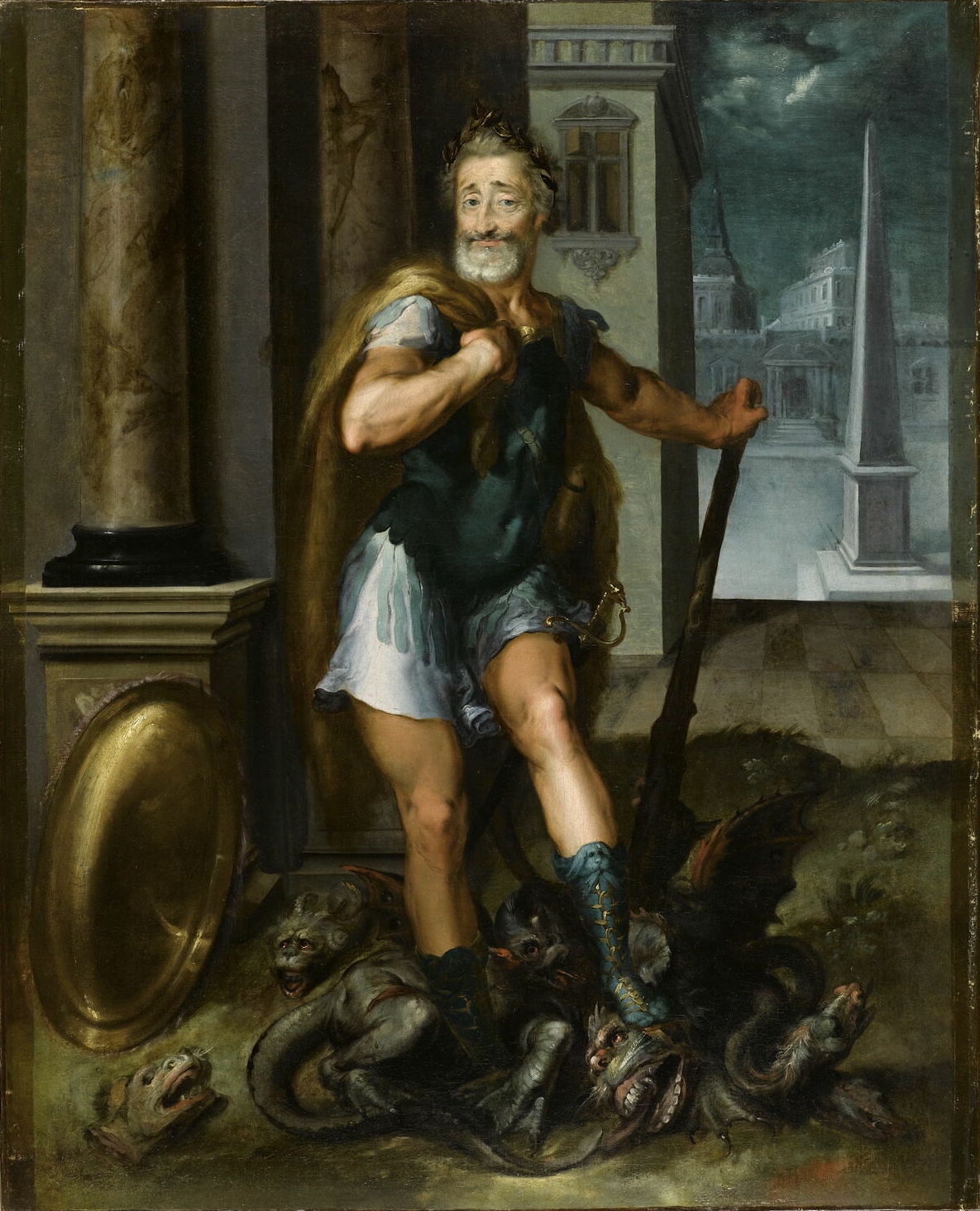
Portrait of Henry IV as Hercules Slaying the Lernaean Hydra by Toussaint Dubreuil (1561–1600) (Public Domain)

Another more modern application of the ancient Hydra occurs in the field of biology: Hydra refers to the genus of fresh-water organisms (related to jellyfish) that have a tubular body featuring a mouth at one end surrounded by an array of tentacles. Like its mythological namesake, a Hydra can regenerate damaged tissue: when cut in half, each half can grow into a whole, complete Hydra. Similarly, like the Lernaean Hydra, these creatures may be quasi-immortal. The same biological factors that allow Hydra to regenerate tissue mean that they do not senesce, or grow old. 

Hydra attached to a substrate (© Creative Commons 
Attribution-Share Alike 3.0 Unported/Stephen Friedt)

The Hydra, with its symbolic and scientific iterations, illustrates how Greek and Roman myth continues to live on in new, often unexpected ways. Students may enjoy discussing other mythological figures that have taken on new meanings in the modern world. 

Still curious about how the ancients described the Hydra? In Ovid’s Metamorphoses (9.67–72) Hercules competes with the river god Achelous for Deianira’s hand in marriage. Taunting the god, he boasts about his victory over the Hydra, a feat that he claims was much more difficult than the one he is about to perform. Here, Hercules claims that the Hydra he vanquished had one-hundred heads!

“cunarum labor est angues superare mearum,”
dixit “et ut vincas alios, Acheloe, dracones,
pars quota Lernaeae serpens eris unus echidnae?
Vulneribus fecunda suis erat illa, nec ullum
de centum numero caput est inpune recisum,
quin gemino cervix herede valentior esset.
Hanc ego ramosam natis e caede colubris
crescentemque malo domui domitamque reclusi.”

“It was the pastime of my cradle days
to strangle better snakes than you—and though
your great length may excel all of your kind,
how small a part of that Lernaean snake
would you—one serpent be? It grew from wounds
I gave (at first it had one-hundred heads)
and every time I severed one head from
its neck two grew there in the place of one,
by which its strength increased. This creature then
outbranching with strong serpents, sprung from death
and thriving on destruction, I destroyed.”

Translation in Ovid’s Metamorphoses by Brookes Moore


–Amelia Wallace, Editor

Thursday, January 09, 2020

Mythological Monster of the Month: Griffin


January’s Roman Calendar Feature
The 2019–2020 Roman Calendar features twelve mythical monsters from the 2019 edition of Martia Dementia, Bolchazy-Carducci’s annual spring bracket tournament. Visit us on social media (Facebook, Twitter, and our blog) for announcements regarding the 2020 Martia Dementia.

January’s monster of the month is the majestic griffin, which according to legend had the body of a lion and the head and wings of an eagle. The January image in the 2020 Roman Calendar shows a detail of a griffin taken from a fourth-century BCE tomb painting found in Paestum, Italy. In the full fresco, two griffins—note the leonine hindquarters and tail, massive feathered wings, and curved beaks—attack a panther, poised to pounce.

Two griffins and a panther, Lucanian fresco in the Museo Archeologico Nazionale
(© Creative Commons Attribution-Share Alike 3.0 Unported/Sailko)
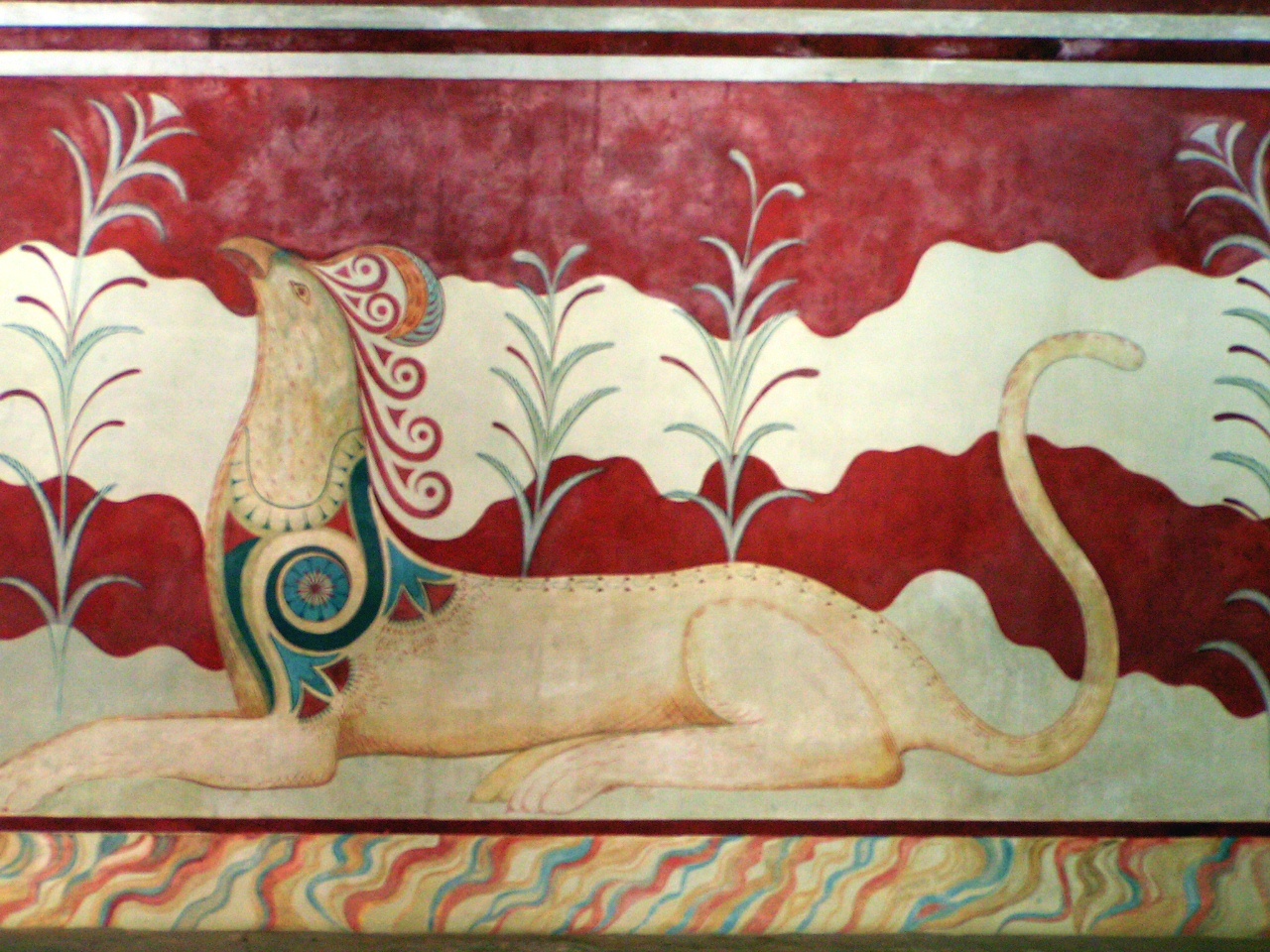
The griffin’s mythical origins lie in the ancient near east and Egypt, with depictions of the creature first appearing around 3,000 BCE. By the fifteenth century BCE, griffin imagery had made its way to the Greek world: the hybrid beast was vibrantly portrayed in a fresco found in the “Throne Room” in the Palace of Knossos on Crete. The griffin remained a popular artistic motif in much of the ancient Mediterranean world, and its prominence continued into the medieval era, when the griffin became a common symbol in heraldry. Griffins were not only used in medieval Christian art, but also in Islamic art of the same time period. The Pisa Griffin, a massive bronze sculpture created in eleventh-century Al-Andalus (modern-day Spain), incorporates Arabic text and patterns associated with textile designs.

 Griffin fresco in the “Throne Room,” Palace of Knossos, Crete
(© Creative Commons Attribution-Share Alike 3.0 Unported/Paginazero)

The Pisa Griffin, an eleventh-century bronze now in the Pisa Cathedral, was originally
 a fountain spout (© Creative Commons Attribution-Share Alike 3.0 Unported/Memorato)

While there are few early written accounts of the griffin, several Greek and Roman writers described griffins as the guardians of gold deposits located in Anatolia, Central Asia, or India. Various authors, including Pliny the Elder (see excerpt below), have detailed the enmity between the griffins and the Arimaspians, a neighboring tribe of one-eyed men who perpetually tried to steal the griffins’ gold. These legends of the griffin continued into the middle ages, and griffins were frequently featured in medieval bestiaries. The griffin still captures the imagination of writers today: the griffin makes an appearance in The Sons of Neptune by Rick Riordan. In the Harry Potter series by J.K. Rowling, Harry and his friends are sorted into the Hogwarts house of Gryffindor, a name that evokes the bravery, strength—and even the ferocity—of the mythical griffin. The hippogriff, a related creature that is half-lion, half-horse, plays an important role in Rowling’s Harry Potter and the Prisoner of Azkaban.

When discussing with students, ask where else they have seen the griffin. Answers may include other stories or literature, as well as architectural motifs, coats of arms, and logos.

Pliny’s Account

In the passage excerpted below from Natural History 7.10, Pliny describes the battles between the Arimaspians and the monstrous griffins, citing Herodotus and Aristeas of Proconnesus as his sources:
 
sed iuxta eos, qui sunt ad septentrionem versi, haut procul ab ipso aquilonis exortu specuque eius dicto, quem locum Gesclithron appellant, produntur Arimaspi, quos diximus, uno oculo in fronte media insignes. quibus adsidue bellum esse circa metalla cum Grypis, ferarum volucri genere, quale vulgo traditur, eruente ex cuniculis aurum, mira cupiditate et feris custodientibus et Arimaspis rapientibus, multi, sed maxime inlustres Herodotus et Aristeas Proconnesius scribunt.
In the vicinity also of those who dwell in the northern regions, and not far from the spot from which the north wind arises, and the place which is called its cave, and is known by the name of Geskleithron, the Arimaspians are said to exist, whom I have previously mentioned, a nation remarkable for having but one eye, and that placed in the middle of the forehead. This race is said to carry on a perpetual warfare with the Griffins, a kind of monster, with wings, as they are commonly represented, for the gold which they dig out of the mines, and which these wild beasts retain and keep watch over with a singular degree of cupidity, while the Arimaspians are equally desirous to get possession of it. Many authors have stated to this effect, among the most illustrious of whom are Herodotus and Aristeas of Proconnesus.
translation in The Natural History of Pliny the Elder by John Bostock


—Amelia Wallace, Editor