
January’s
Roman Calendar Feature
The 2019–2020 Roman Calendar features
twelve mythical monsters from the 2019 edition of Martia Dementia,
Bolchazy-Carducci’s annual spring bracket tournament. Visit us on social media
(Facebook, Twitter, and our blog) for announcements regarding the 2020 Martia
Dementia.
January’s monster of the month is the majestic griffin, which
according to legend had the body of a lion and the head and wings of
an eagle. The January image in the 2020 Roman Calendar shows a detail of a
griffin taken from a fourth-century BCE tomb painting found in Paestum, Italy.
In the full fresco, two griffins—note the leonine hindquarters and tail,
massive feathered wings, and curved beaks—attack a panther, poised to pounce.
 |
| Two griffins and a panther, Lucanian fresco in the Museo Archeologico Nazionale (© Creative Commons Attribution-Share Alike 3.0 Unported/Sailko) |
The griffin’s mythical origins lie in the ancient near east
and Egypt, with depictions of the creature first appearing around 3,000 BCE. By
the fifteenth century BCE, griffin imagery had made its way to the Greek world:
the hybrid beast was vibrantly portrayed in a fresco found in the “Throne Room”
in the Palace of Knossos on Crete. The griffin remained a popular artistic
motif in much of the ancient Mediterranean world, and its prominence continued
into the medieval era, when the griffin became a common symbol in heraldry. Griffins
were not only used in medieval Christian art, but also in Islamic art of the
same time period. The Pisa Griffin, a massive bronze sculpture created in
eleventh-century Al-Andalus (modern-day Spain), incorporates Arabic text and
patterns associated with textile designs.
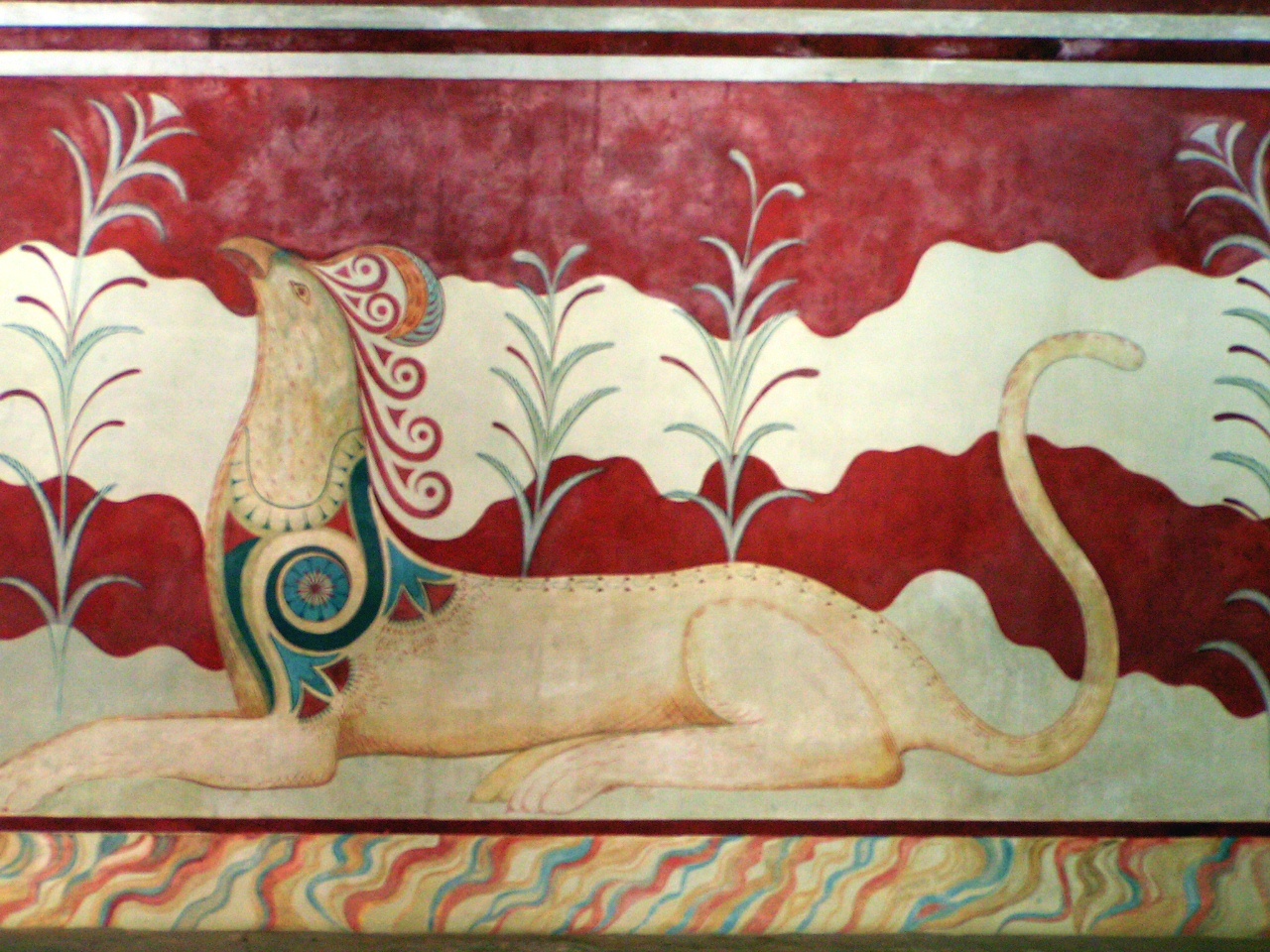 |
| Griffin fresco in the “Throne Room,” Palace of Knossos, Crete (© Creative Commons Attribution-Share Alike 3.0 Unported/Paginazero) |
 |
| The Pisa Griffin, an eleventh-century bronze now in the Pisa Cathedral, was originally a fountain spout (© Creative Commons Attribution-Share Alike 3.0 Unported/Memorato) |
While there are few early written accounts of the griffin, several
Greek and Roman writers described griffins as the guardians of gold deposits
located in Anatolia, Central Asia, or India. Various authors, including Pliny
the Elder (see excerpt below), have detailed the enmity between the griffins
and the Arimaspians, a neighboring tribe of one-eyed men who perpetually
tried to steal the griffins’ gold. These legends of the griffin continued into
the middle ages, and griffins were frequently featured in medieval bestiaries. The
griffin still captures the imagination of writers today: the griffin makes an
appearance in The Sons of Neptune by
Rick Riordan. In the Harry Potter series by J.K. Rowling, Harry and his friends
are sorted into the Hogwarts house of Gryffindor,
a name that evokes the bravery, strength—and even the ferocity—of the mythical
griffin. The hippogriff, a related creature that is half-lion, half-horse,
plays an important role in Rowling’s Harry
Potter and the Prisoner of Azkaban.
When discussing with students, ask where
else they have seen the griffin. Answers may include other stories or literature,
as well as architectural motifs, coats of arms, and logos.
Pliny’s Account
In the passage excerpted below from Natural History 7.10, Pliny describes
the battles between the Arimaspians and the monstrous griffins, citing
Herodotus and Aristeas of Proconnesus as his sources:
sed iuxta eos, qui sunt ad septentrionem versi, haut procul ab ipso aquilonis exortu specuque eius dicto, quem locum Gesclithron appellant, produntur Arimaspi, quos diximus, uno oculo in fronte media insignes. quibus adsidue bellum esse circa metalla cum Grypis, ferarum volucri genere, quale vulgo traditur, eruente ex cuniculis aurum, mira cupiditate et feris custodientibus et Arimaspis rapientibus, multi, sed maxime inlustres Herodotus et Aristeas Proconnesius scribunt.
In the vicinity also of those who dwell in the northern regions, and not far from the spot from which the north wind arises, and the place which is called its cave, and is known by the name of Geskleithron, the Arimaspians are said to exist, whom I have previously mentioned, a nation remarkable for having but one eye, and that placed in the middle of the forehead. This race is said to carry on a perpetual warfare with the Griffins, a kind of monster, with wings, as they are commonly represented, for the gold which they dig out of the mines, and which these wild beasts retain and keep watch over with a singular degree of cupidity, while the Arimaspians are equally desirous to get possession of it. Many authors have stated to this effect, among the most illustrious of whom are Herodotus and Aristeas of Proconnesus.
translation in The Natural History of Pliny the Elder
by John Bostock
—Amelia Wallace, Editor

