Showing posts with label Latin literature. Show all posts

Tuesday, February 11, 2020

Mythological Monster of the Month: Hydra


February’s Roman Calendar Feature

The 2019–2020 Roman Calendar features twelve mythical monsters from the 2019 edition of Martia Dementia, Bolchazy-Carducci’s annual spring bracket tournament. Visit us on social media (Facebook, Twitter, and our blog) for announcements regarding the 2020 Martia Dementia—starting later this month!

Behold, the Lernaean Hydra! According to Hesiod, this many-headed serpentine creature was the offspring of Typhon and Echidna, prolific parents of some of Greek mythology’s most famous monsters. An inhabitant of the liminal lake Lerna, the Hydra breathed out poisonous vapors that made the environs nearly impossible for mortals to even approach. Heracles, during his twelve labors, was tasked with slaying the Hydra—no easy feat, especially because as Heracles severed one Hydra head, two more grew in its place. Unable to defeat the Hydra on his own, Heracles asked his nephew Iolaus for help. While Heracles sliced away each head, Iolaus used a firebrand to cauterize the wounds, preventing the Hydra from regenerating.


Hydra, sixth-century bce Caeretan hydria (water vessel) 
(Digital image courtesy of the Getty’s Open Content Program)

A victorious Heracles dipped his arrows in the Hydra’s poisonous blood, creating a potent weapon that helped him accomplish several of his other labors—but would ultimately be his own downfall. The body of the Hydra was placed in the sky as the constellation Hydra, which has a shape resembling a twisting snake. This constellation is the largest of the eighty-eight modern constellations.

The Hydra depicted among eleven other constellations, 
nineteenth-century star chart card from a set known as Urania’s Mirror 
(Public Domain, restored by Adam Cuerden)

Today, the term “hydra” is often used to refer to an intractable problem that is not easily solved; as when Heracles attempted to slay the mythical Hydra, an attempt to find a solution results in new problems cropping up. King Henry IV of France chose to portray himself as Hercules (the Roman name for Heracles) standing over a vanquished Hydra after he brought an end to France’s internecine religious wars at the end of the sixteenth century. In the painting, Henry—sporting a rather self-satisfied facial expression—casually stands over the beheaded monster, representing his recent political enemy, the Catholic League.
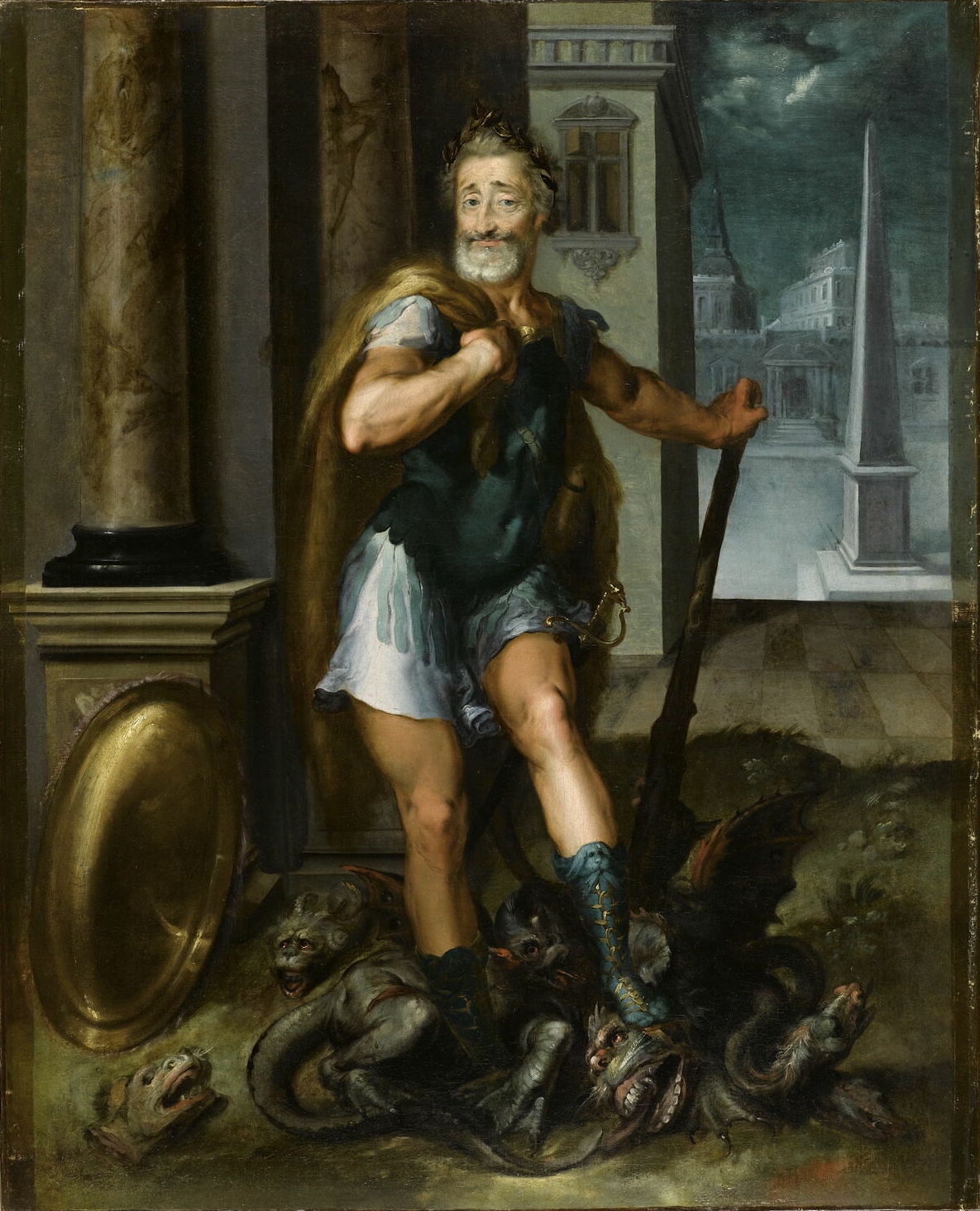
Portrait of Henry IV as Hercules Slaying the Lernaean Hydra by Toussaint Dubreuil (1561–1600) (Public Domain)

Another more modern application of the ancient Hydra occurs in the field of biology: Hydra refers to the genus of fresh-water organisms (related to jellyfish) that have a tubular body featuring a mouth at one end surrounded by an array of tentacles. Like its mythological namesake, a Hydra can regenerate damaged tissue: when cut in half, each half can grow into a whole, complete Hydra. Similarly, like the Lernaean Hydra, these creatures may be quasi-immortal. The same biological factors that allow Hydra to regenerate tissue mean that they do not senesce, or grow old. 

Hydra attached to a substrate (© Creative Commons 
Attribution-Share Alike 3.0 Unported/Stephen Friedt)

The Hydra, with its symbolic and scientific iterations, illustrates how Greek and Roman myth continues to live on in new, often unexpected ways. Students may enjoy discussing other mythological figures that have taken on new meanings in the modern world. 

Still curious about how the ancients described the Hydra? In Ovid’s Metamorphoses (9.67–72) Hercules competes with the river god Achelous for Deianira’s hand in marriage. Taunting the god, he boasts about his victory over the Hydra, a feat that he claims was much more difficult than the one he is about to perform. Here, Hercules claims that the Hydra he vanquished had one-hundred heads!

“cunarum labor est angues superare mearum,”
dixit “et ut vincas alios, Acheloe, dracones,
pars quota Lernaeae serpens eris unus echidnae?
Vulneribus fecunda suis erat illa, nec ullum
de centum numero caput est inpune recisum,
quin gemino cervix herede valentior esset.
Hanc ego ramosam natis e caede colubris
crescentemque malo domui domitamque reclusi.”

“It was the pastime of my cradle days
to strangle better snakes than you—and though
your great length may excel all of your kind,
how small a part of that Lernaean snake
would you—one serpent be? It grew from wounds
I gave (at first it had one-hundred heads)
and every time I severed one head from
its neck two grew there in the place of one,
by which its strength increased. This creature then
outbranching with strong serpents, sprung from death
and thriving on destruction, I destroyed.”

Translation in Ovid’s Metamorphoses by Brookes Moore


–Amelia Wallace, Editor

Thursday, January 09, 2020

Mythological Monster of the Month: Griffin


January’s Roman Calendar Feature
The 2019–2020 Roman Calendar features twelve mythical monsters from the 2019 edition of Martia Dementia, Bolchazy-Carducci’s annual spring bracket tournament. Visit us on social media (Facebook, Twitter, and our blog) for announcements regarding the 2020 Martia Dementia.

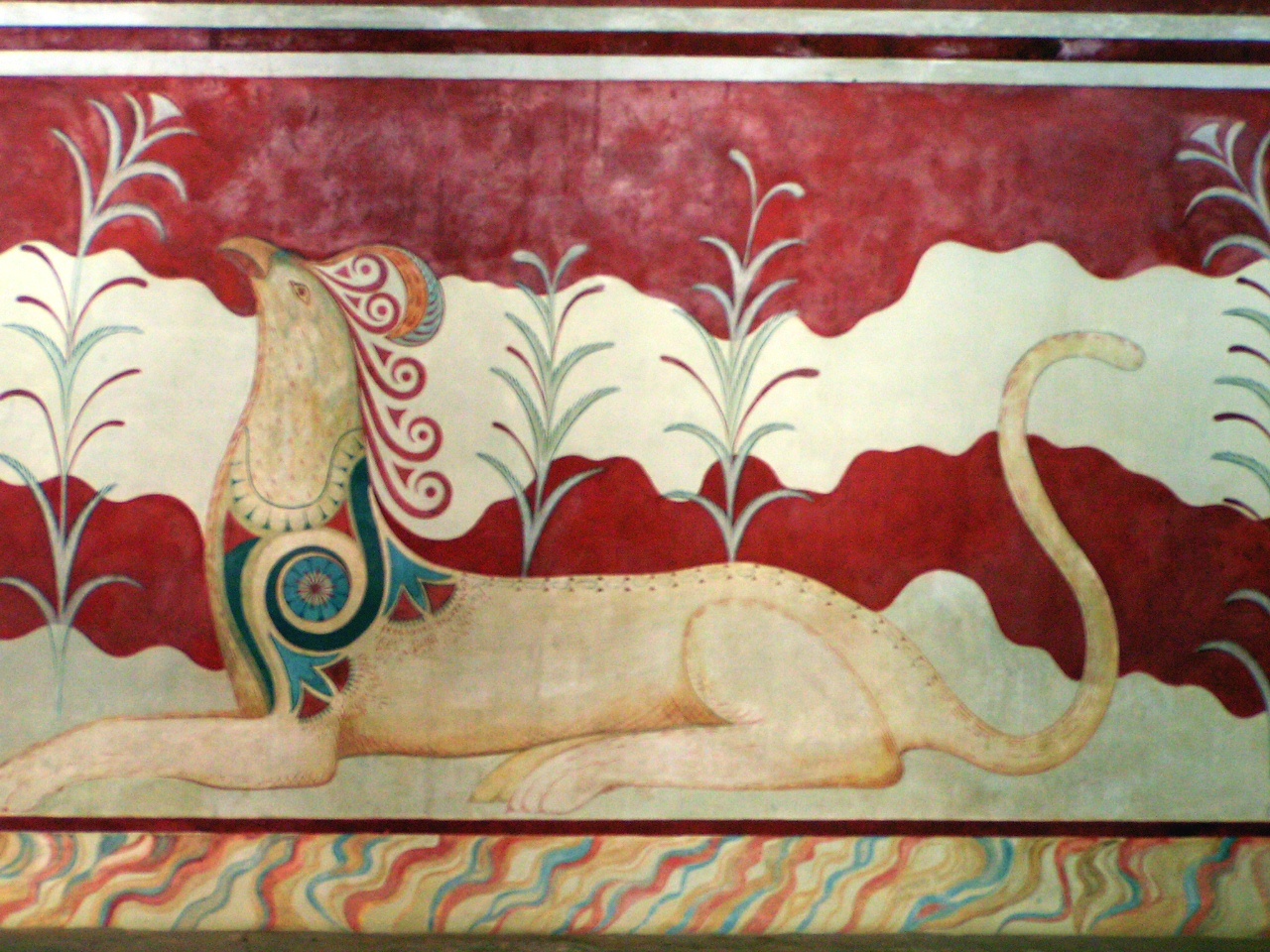
January’s monster of the month is the majestic griffin, which according to legend had the body of a lion and the head and wings of an eagle. The January image in the 2020 Roman Calendar shows a detail of a griffin taken from a fourth-century BCE tomb painting found in Paestum, Italy. In the full fresco, two griffins—note the leonine hindquarters and tail, massive feathered wings, and curved beaks—attack a panther, poised to pounce.

Two griffins and a panther, Lucanian fresco in the Museo Archeologico Nazionale
(© Creative Commons Attribution-Share Alike 3.0 Unported/Sailko)
The griffin’s mythical origins lie in the ancient near east and Egypt, with depictions of the creature first appearing around 3,000 BCE. By the fifteenth century BCE, griffin imagery had made its way to the Greek world: the hybrid beast was vibrantly portrayed in a fresco found in the “Throne Room” in the Palace of Knossos on Crete. The griffin remained a popular artistic motif in much of the ancient Mediterranean world, and its prominence continued into the medieval era, when the griffin became a common symbol in heraldry. Griffins were not only used in medieval Christian art, but also in Islamic art of the same time period. The Pisa Griffin, a massive bronze sculpture created in eleventh-century Al-Andalus (modern-day Spain), incorporates Arabic text and patterns associated with textile designs.

 Griffin fresco in the “Throne Room,” Palace of Knossos, Crete
(© Creative Commons Attribution-Share Alike 3.0 Unported/Paginazero)

The Pisa Griffin, an eleventh-century bronze now in the Pisa Cathedral, was originally
 a fountain spout (© Creative Commons Attribution-Share Alike 3.0 Unported/Memorato)

While there are few early written accounts of the griffin, several Greek and Roman writers described griffins as the guardians of gold deposits located in Anatolia, Central Asia, or India. Various authors, including Pliny the Elder (see excerpt below), have detailed the enmity between the griffins and the Arimaspians, a neighboring tribe of one-eyed men who perpetually tried to steal the griffins’ gold. These legends of the griffin continued into the middle ages, and griffins were frequently featured in medieval bestiaries. The griffin still captures the imagination of writers today: the griffin makes an appearance in The Sons of Neptune by Rick Riordan. In the Harry Potter series by J.K. Rowling, Harry and his friends are sorted into the Hogwarts house of Gryffindor, a name that evokes the bravery, strength—and even the ferocity—of the mythical griffin. The hippogriff, a related creature that is half-lion, half-horse, plays an important role in Rowling’s Harry Potter and the Prisoner of Azkaban.

When discussing with students, ask where else they have seen the griffin. Answers may include other stories or literature, as well as architectural motifs, coats of arms, and logos.

Pliny’s Account

In the passage excerpted below from Natural History 7.10, Pliny describes the battles between the Arimaspians and the monstrous griffins, citing Herodotus and Aristeas of Proconnesus as his sources:
 
sed iuxta eos, qui sunt ad septentrionem versi, haut procul ab ipso aquilonis exortu specuque eius dicto, quem locum Gesclithron appellant, produntur Arimaspi, quos diximus, uno oculo in fronte media insignes. quibus adsidue bellum esse circa metalla cum Grypis, ferarum volucri genere, quale vulgo traditur, eruente ex cuniculis aurum, mira cupiditate et feris custodientibus et Arimaspis rapientibus, multi, sed maxime inlustres Herodotus et Aristeas Proconnesius scribunt.
In the vicinity also of those who dwell in the northern regions, and not far from the spot from which the north wind arises, and the place which is called its cave, and is known by the name of Geskleithron, the Arimaspians are said to exist, whom I have previously mentioned, a nation remarkable for having but one eye, and that placed in the middle of the forehead. This race is said to carry on a perpetual warfare with the Griffins, a kind of monster, with wings, as they are commonly represented, for the gold which they dig out of the mines, and which these wild beasts retain and keep watch over with a singular degree of cupidity, while the Arimaspians are equally desirous to get possession of it. Many authors have stated to this effect, among the most illustrious of whom are Herodotus and Aristeas of Proconnesus.
translation in The Natural History of Pliny the Elder by John Bostock


—Amelia Wallace, Editor


Wednesday, September 18, 2019

Mythological Monster of the Month: Argus


September’s Roman Calendar Feature

The 2019–2020 Roman Calendar features twelve mythical monsters from the 2019 edition of Martia Dementia, Bolchazy-Carducci’s annual spring bracket tournament. Visit us on social media (Facebook, Twitter, and our blog) for announcements regarding the 2020 Martia Dementia.

Argus by Pintoricchio (Bernardino di Betto, 1454–1513) (Public Domain)
September’s Roman Calendar image highlights Argus, sometimes called Panoptes (Greek for “all-seeing”), famous for his hundred eyes. Argus is perhaps best known for his role in the story of Io, a young woman turned into a heifer because of Jupiter’s lust for her. Some sources say that Jupiter transformed Io in an effort to hide her from Juno, while others say that Juno transformed her as punishment. Regardless, Juno charged Argus with watching over Io in the form of the heifer to prevent Jupiter from visiting her again. Jupiter then sent Mercury to slay Argus and free Io.

Pintoricchio (1454–1513), whose name means “little painter” in Italian, was a Renaissance painter known for his frescoes. Though his real name was Bernardino di Betto, he acquired the nickname Pintoricchio due to his short stature. This fresco appears in the Room of the Saints in the Vatican’s Borgia Apartment. The room takes its name from large frescoes depicting seven Christian saints. Smaller frescoes of scenes from Egyptian and classical mythology feature bulls (or, in Io’s case, a heifer) in reference to Pope Alexander VI (1431–1503), whose heraldic emblem was a bull. Please note that for the calendar, the border of the image (including Io) was cropped to better display Argus’s features.

Sixth-century bce Greek vase depicting Argus and Io (Public Domain)
Depictions of Argus don’t always feature extra eyes, as in this sixth-century bce Greek black-figure vase. Found in Italy, it is now in the collection of the Staatliche Antikensammlungen in Munich, Germany.

Teachers may wish to ask students to compare and contrast the images above with Ovid’s description below, using the Latin or English texts as appropriate for the class.

Ovid describes Argus in his Metamorphoses (1.622–629)


Latin (text and notes from A. G. Lee’s Ovid: Metamorphoses Book I)

paelice donata non protinus exuit omnem
diva metum, timuitque Iovem et fuit anxia furti
donec Arestoridae servandam tradidit Argo.
centum luminibus cinctum caput Argus habebat;         625
inde suis vicibus capiebant bina quietem,
cetera servabant atque in statione manebant.
constiterat quocumque modo, spectabat ad Io;
ante oculos Io, quamvis aversus, habebat.
(p. 62)

622
exuit: cf. Am. 3, 4, 43-4: 'vultusque severos / exue', Cic. Att. 13, 2, 1: 'humanitatem omnem exuimus'.

623
-que: 'but'; cf. 15 n.
furti: cf. 606 n.

624
Arestoridae: the only occurrence of this patronymic in Latin poetry. Arestor was a shadowy Argive hero.

625
centum . . . cinctum: for the similarity of sound cf. 489: 'vetat votoque', 633: 'toro terrae', 739: 'fitque quod ante fuit'.

626
inde: 'of these'; cf. Plaut. Mil. 711: 'dant in de partem mihi', Met.13,829: 'lac mihi semper adest niveum: pars inde bibenda / servatur . . . ' The French en derives from this word.
suis vicibus: 'in their turn', cf. 4, 218: 'noxque vicem peragit', 'night takes her turn, completes her round'.

627
servabant: the word is used absolutely as in 684, cf. Pl. Most. 451: 'nemo in aedibus servat'; it is prob. from the military vocabulary. serva is frequent in the comedians in the sense of 'look out, take care', cf. Gk. φυλάττου.
in statione: 'on duty, at their post'; another military phrase. Cf. Caes. B.C. 1, 43 : 'quae in statione pro castris erant Afranii cohortes'; Cic. Sen. 73: 'de praesidia et statione vitae decedere'.

628-9
Ovidian repetition to drive the point home.      
(p. 133)

English

Juno regardful of Jove's cunning art,
lest he might change her to her human form,
gave the unhappy heifer to the charge
of Argus, Aristorides, whose head                               
was circled with a hundred glowing eyes;
of which but two did slumber in their turn
whilst all the others kept on watch and guard.

translation by Brookes More (1922) available at Perseus


—Laurel Draper, Editor

Wednesday, October 30, 2013

Introduce your students to a variety of unadapted Latin authors!

Latin for the New Millennium
Latin 3 Select Latin Enrichment Readings
Edited by LeaAnn Osburn and Helena Dettmer

xxvi + 160 pp. (2013) Paperback, ISBN 978-0-86516-797-1

This short reader offers exposure to Caesar, Catullus, Cicero, Horace, Ovid, and Vergil as well as the baroque-era poets Lieven De Meyere and Mathias Casimir Sarbiewski. Ample notes and vocabulary aids assist students reading these unadapted Latin passages. Incorporate this reader near the end of your grammar lessons to accustom students to reading a variety of unadapted Latin authors and genres, use it to fill those last 3 to 4 weeks of the semester after finishing Latin 2, or use it as an enrichment text for Latin 3.

  • Unadapted Latin text from Caesar, Catullus, Cicero, Horace, Ovid, Vergil, and the baroque-era poets Lieven De Meyere and Mathias Casimir Sarbiewski
  • Same-page notes and vocabulary
  • Appendices on Meter and Rhetorical Terms
  • Latin to English Glossary

Helena Dettmer is a Professor of Classics and Associate Dean for Undergraduate Programs at the University of Iowa. She earned her BA in Classics at Indiana University and a PhD from the University of Michigan. Dettmer received the University of Iowa’s 2012 Lola Lopes Award for Undergraduate Student Advocacy. A former Mellow Fellow at Duke University, a recipient of the Iowa May Brodbeck Humanities Fellowship, an Iowa Faculty Scholar, and an Iowa collegiate fellow, and past president of the Classical Association of the Middle West and South, Helena Dettmer has authored two monographs on the intersection of meaning and structure in Latin poetry, Horace: A Study in Structure (Hildesheim 1983), and Love by the Numbers: Form and Meaning in the Poetry of Catullus (New York, 1997). She is coauthor of A Workbook to Ayers’ English Words from Latin and Greek Elements, in its second printing and used widely in vocabulary-building courses around the country, as well as A Catullus Workbook, which she coauthored with LeaAnn Osburn. Her current project is a book-length study examining the poetic structure of Ovid’s Amores.

LeaAnn A. Osburn received her BA from Monmouth College, Illinois and an MA in classics from Loyola University Chicago. She taught Latin including AP* for many years at Barrington High School in Illinois. Osburn received an American Classical League Emerita Award in 2012. She served as both vice-president and president of the Illinois Classical Conference and received their Lifetime Achievement Award in 2008. Osburn received the Illinois Latin Teacher of the Year Award (1989), the Illinois Lt. Governor’s Award (1990), and the CAMWS Good Teacher Award (1996). She coauthored A Catullus Workbook (2006) and Teacher’s Manual (2006) with Helena Dettmer, Vergil: A Legamus Transitional Reader (2004) with Thomas J. Sienkewicz and the Vergil: A Legamus Transitional Reader Teacher’s Guide (2010) with Karen Lee Singh. Osburn served as the series editor for Latin for the New Millennium, Levels 1 and 2.


For complete information about Bolchazy-Carducci Publishers Latin for the New Millennium textbook series visit the LNM website.

Friday, August 16, 2013

bolchazy.com has a new look and more!!!

bolchazy.com New Look
As part of our ongoing efforts to offer the best customer experience possible, Bolchazy-Carducci Publishers is happy to announce that our new website is LIVE. The new site has many upgrades including a new, streamlined shopping cart and better navigability.
 
We hope you enjoy exploring the new site. Keep your eyes open for a video tour of the new features. Please be aware that, if you have ordered online from us before, the new shopping cart will require you to change your password. If you are a new online customer, you will need to create a login before placing your first order.

and More!!!
Two more webinars have been added to our 2013 Fall Webinar Schedule. Bolchazy-Carducci Publishers is offering SIX informative webinars this fall including a
Special Triad of Webinars on “Helping Students Make Connections”. These three webinars
developed by creative veterans of the Latin classroom, present a laddered approach to teaching students to look for, recognize, and appreciate the role of connections in Latin literature. Two Latin for the New Millennium webinars are scheduled and one webinar by author Ronnie Ancona on Teaching “Uncensored” Catullus. 

Great webinar line-up sure to be informative and engaging to join us register on line.