Showing posts with label Latin teacher. Show all posts

Thursday, March 05, 2020

3 Martia Dementia In-Class Activities (+ Free Printables and More!)


In Martia Dementia 2020, the mythological monsters have returned—all thirty-two of them! If you'd like some materials to use with your students to provide background information on these ancient figures, look no further. Bolchazy-Carducci has created blog posts addressing the artistic, literary, and historical significance of six of these creatures. These posts are an excellent starting point for completing research or acquiring basic knowledge. We are also providing very short summaries of the mythological figures, all contained within a printable PDF. Find the links to these resources below.

Need some ideas for covering this year's Martia Dementia field in class? One simple, quick activity for ensuring a basic familiarity is the game Two Truths and a Lie. Simply print out the mythological monster biography sheet linked below. Cut the sheet into strips so that you can individually assign each figure to a student (or a group of students). After learning a little about their assigned figure, each student then presents two truths and one lie about the monster to the class, which has to guess which is fact and which is fiction.

For a more complex activity, ask students to use the Bolchazy-Carducci materials as a starting point to complete additional research on an assigned monster. Using what they have learned, they then craft a persuasive presentation on why their monster should win all of Martia Dementia. After students have sufficiently debated each figure's merits, they can then vote on which figure "deserves" to win. (In fact, this activity can be used to determine a full-class bracket, though you may want to also incorporate the ancient military leaders into this activity; we will be posting biographies for these figures as well at the bottom of the page.)

Looking for other ideas? This year, we are also pleased to provide some free printables and online activities: we have created all of the pieces for a mythological monster Guess Who?–inspired game, Quis Est? If you have the boards at hand, all you will need to do is print out two sets of small cards to insert in the boards and one set of larger cards. We have also provided colorful backings reminiscent of the color scheme of the original game—print these on the back of your cards if you'd really like to have that 1980s-feel. (If you want a simpler set-up, we can confirm that simply printing the small cards on regular paper and then slipping the paper in front of the game's original cardboard pieces works as well.) Regular Guess Who? rules apply, but with this unusual cast of characters, game play is quite challenging. Students will need to know a lot about these monsters to be able to ask incisive questions (and then, understand the answers and accurately flip down the incorrect monsters). To assist with game play, we are also providing a worksheet that students can complete to assess their knowledge.

As an added bonus, we have a short online activity that students can play to practice what they have learned about the mythological monsters before or after playing Quis Est? This activity, which we are making freely accessible, is built on our Lumina platform. Note that the crossword puzzle is replayable: merely hit "re-start," and a new configuration (with varying sets of words) becomes available. Click here or see the link below to play these online games.

Do you use any class or Latin club activities that incorporate Martia Dementia? Let us know in the comments!

Monster of the Month Blog Posts


Printable Materials


Thursday, January 09, 2020

Mythological Monster of the Month: Griffin


January’s Roman Calendar Feature
The 2019–2020 Roman Calendar features twelve mythical monsters from the 2019 edition of Martia Dementia, Bolchazy-Carducci’s annual spring bracket tournament. Visit us on social media (Facebook, Twitter, and our blog) for announcements regarding the 2020 Martia Dementia.

January’s monster of the month is the majestic griffin, which according to legend had the body of a lion and the head and wings of an eagle. The January image in the 2020 Roman Calendar shows a detail of a griffin taken from a fourth-century BCE tomb painting found in Paestum, Italy. In the full fresco, two griffins—note the leonine hindquarters and tail, massive feathered wings, and curved beaks—attack a panther, poised to pounce.

Two griffins and a panther, Lucanian fresco in the Museo Archeologico Nazionale
(© Creative Commons Attribution-Share Alike 3.0 Unported/Sailko)
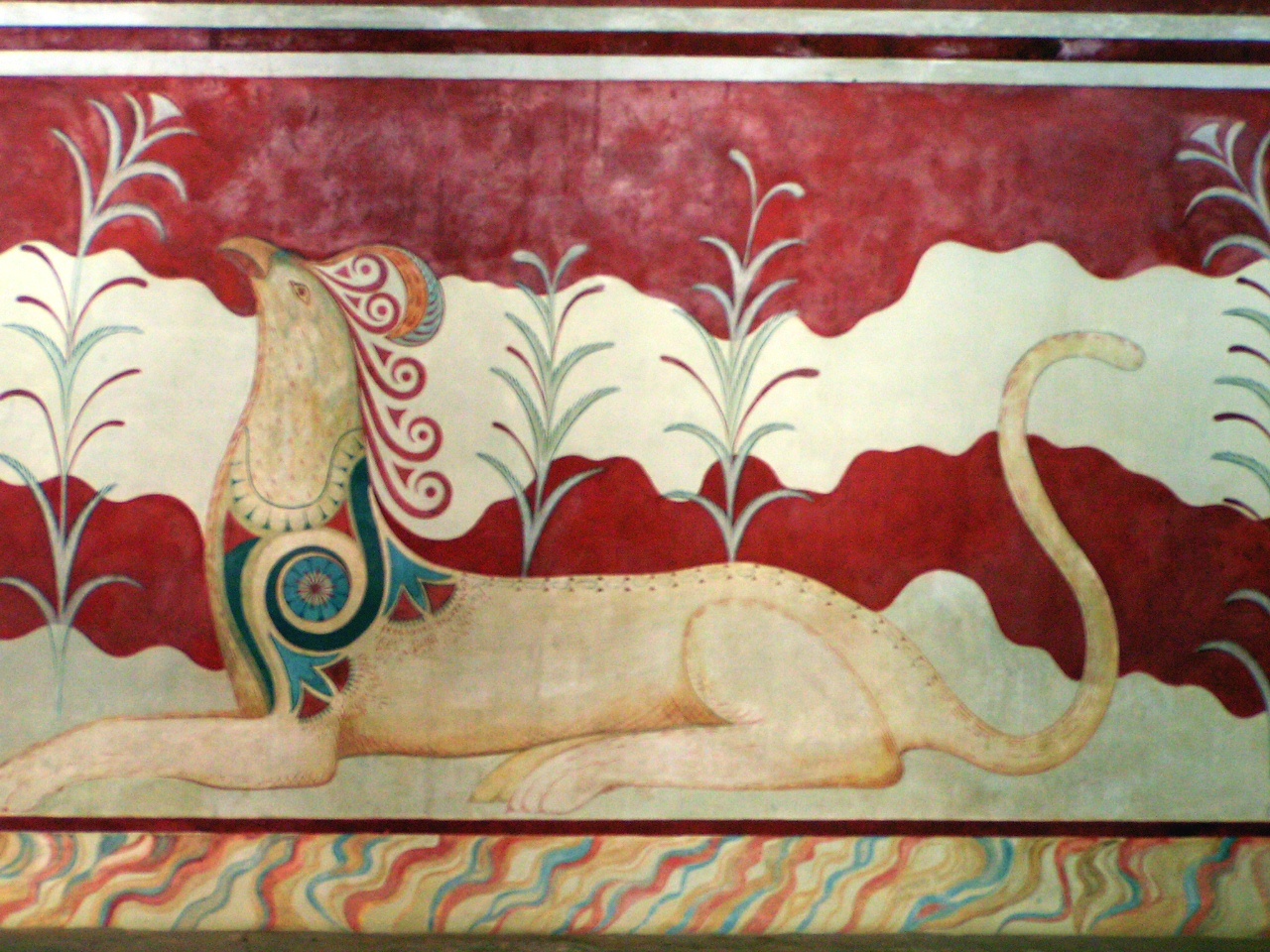
The griffin’s mythical origins lie in the ancient near east and Egypt, with depictions of the creature first appearing around 3,000 BCE. By the fifteenth century BCE, griffin imagery had made its way to the Greek world: the hybrid beast was vibrantly portrayed in a fresco found in the “Throne Room” in the Palace of Knossos on Crete. The griffin remained a popular artistic motif in much of the ancient Mediterranean world, and its prominence continued into the medieval era, when the griffin became a common symbol in heraldry. Griffins were not only used in medieval Christian art, but also in Islamic art of the same time period. The Pisa Griffin, a massive bronze sculpture created in eleventh-century Al-Andalus (modern-day Spain), incorporates Arabic text and patterns associated with textile designs.

 Griffin fresco in the “Throne Room,” Palace of Knossos, Crete
(© Creative Commons Attribution-Share Alike 3.0 Unported/Paginazero)

The Pisa Griffin, an eleventh-century bronze now in the Pisa Cathedral, was originally
 a fountain spout (© Creative Commons Attribution-Share Alike 3.0 Unported/Memorato)

While there are few early written accounts of the griffin, several Greek and Roman writers described griffins as the guardians of gold deposits located in Anatolia, Central Asia, or India. Various authors, including Pliny the Elder (see excerpt below), have detailed the enmity between the griffins and the Arimaspians, a neighboring tribe of one-eyed men who perpetually tried to steal the griffins’ gold. These legends of the griffin continued into the middle ages, and griffins were frequently featured in medieval bestiaries. The griffin still captures the imagination of writers today: the griffin makes an appearance in The Sons of Neptune by Rick Riordan. In the Harry Potter series by J.K. Rowling, Harry and his friends are sorted into the Hogwarts house of Gryffindor, a name that evokes the bravery, strength—and even the ferocity—of the mythical griffin. The hippogriff, a related creature that is half-lion, half-horse, plays an important role in Rowling’s Harry Potter and the Prisoner of Azkaban.

When discussing with students, ask where else they have seen the griffin. Answers may include other stories or literature, as well as architectural motifs, coats of arms, and logos.

Pliny’s Account

In the passage excerpted below from Natural History 7.10, Pliny describes the battles between the Arimaspians and the monstrous griffins, citing Herodotus and Aristeas of Proconnesus as his sources:
 
sed iuxta eos, qui sunt ad septentrionem versi, haut procul ab ipso aquilonis exortu specuque eius dicto, quem locum Gesclithron appellant, produntur Arimaspi, quos diximus, uno oculo in fronte media insignes. quibus adsidue bellum esse circa metalla cum Grypis, ferarum volucri genere, quale vulgo traditur, eruente ex cuniculis aurum, mira cupiditate et feris custodientibus et Arimaspis rapientibus, multi, sed maxime inlustres Herodotus et Aristeas Proconnesius scribunt.
In the vicinity also of those who dwell in the northern regions, and not far from the spot from which the north wind arises, and the place which is called its cave, and is known by the name of Geskleithron, the Arimaspians are said to exist, whom I have previously mentioned, a nation remarkable for having but one eye, and that placed in the middle of the forehead. This race is said to carry on a perpetual warfare with the Griffins, a kind of monster, with wings, as they are commonly represented, for the gold which they dig out of the mines, and which these wild beasts retain and keep watch over with a singular degree of cupidity, while the Arimaspians are equally desirous to get possession of it. Many authors have stated to this effect, among the most illustrious of whom are Herodotus and Aristeas of Proconnesus.
translation in The Natural History of Pliny the Elder by John Bostock


—Amelia Wallace, Editor


Wednesday, October 10, 2018

3 First-Year Teachers Tell Their Stories: Meet M.


(For an introduction to this blog series, see our first post. To read our first two teacher profiles, click here and here.)

Memento mori! M. has enhanced her classroom
door with skeletons for Halloween.

Meet M., a first-year Latin teacher at a small private K–9 school in the metropolitan New York area. M. teaches fourth through eighth grade; her class sizes tend to be small, fewer than ten students each.

Classroom setup: M. has her own classroom; while small, it accommodates her classes well. Her tables are arranged in a square so that everyone can see one another. Because her students are younger, she wants to make sure the room seems “fun”—she has hung up posters showing Pompeii, Roman monuments, and classical art. She also has posted key Latin vocabulary for students to reference during class, including a days of the week poster illustrated using Lego scenes.

Goals: M.’s goals for the year center on organization and communication:
1. Stay organized—there are so many different things to remember in all aspects of teaching!
2. Implement effective communication with parents.
3. Learn how to use movie talks to engage students while preteaching vocabulary and target structures.

Like K., M. also hopes to maintain her work-life balance as she learns all the requirements of her new school, develops curricula for multiple grade levels, and creates a classroom community.

Methodologies and Approaches to Teaching: M. has already begun using comprehensible input (CI)
methods with her younger students. While fourth grade is more of an exploratory class featuring plenty of games and introductory activities, she is experimenting with different active Latin techniques in her fifth and sixth grade classes. Because her seventh and eighth grade students are already accustomed to a grammar-translation approach, she is maintaining a more traditional teaching style in order to avoid derailing them.

Tips and Tricks: M. highly recommends using the Facebook forum Latin Teacher Idea Exchange for inspiration when planning classes. She notes that collaboration is essential; while she is the only Latin teacher at her school, she has a group of Latin teacher friends across the country who can offer support and suggestions when needed.

Most Looking Forward To: M. is most excited about building good relationships with her new students. She is looking forward to the time when her classes know each other well enough to have inside jokes and when her students feel like they can trust and confide in her.

First Day Hook: M. didn’t have a specific means of “hooking” students on the first day of class, but rather focused on getting to know her students and using her energy—and her experience with techniques from the theater—to engage her students.

M.’s first week of school went by in a blur, challenging yet satisfying. She explains:

The first day felt like a whole week. I was utterly exhausted. The spoken Latin with the fifth and sixth graders is a blast, and they are awesome. Hearing students speaking Latin in the halls makes my day—and they aren’t doing it to impress me, I hear it off in the distance! I want to keep this up with them and improve my own spoken Latin abilities.

M.’s enthusiasm and passion for teaching is readily apparent. Good luck during the upcoming school year, M.!

—Amelia Wallace, Editor

Wednesday, October 03, 2018

3 First-Year Teachers Tell Their Stories: Meet K.


(For an introduction to this blog series, see our first post. To read our first teacher profile, click here.)


Students colored in images depicting the foundation myths of Rome.
Many chose to use whimsical color schemes; they then labeled the colors
using the Latin terms.
Meet K., a first-year Latin teacher at a public middle school in the northeast. Students at this school come from a mixture of suburban and rural areas. K. teaches two sections of Latin 1A (seventh grade) and two sections of Latin 1B (eighth grade); she also travels to the neighboring high school, where she teaches Latin 2. K. has explained some of her strategies and goals for the year, as described below.

Classroom setup: While K. has her own devoted classroom for her middle school students, she shares a classroom with two other teachers at the high school. Her middle school classroom has desks set up in pairs to facilitate group work. To brighten up her room, which lacks windows, she is using colorful bulletin board backing. She is leaving some wall space blank in hopes of decorating extensively with student projects, but has already posted a word wall as a helpful reference for students.

Goals: K. has several goals for her first year:
1. Cultivate a love of Latin and the ancient world among her students.
2. Create a classroom environment that feels safe and inclusive for all of her students.
3. Achieve a work-life balance so that she not only meets her students' needs but also attends to her own.

Methodologies and Approaches to Teaching: K. will be building off a curriculum that was already in place when she came to her school. She also will be working with the high school teacher in her district to ensure that her students are well-prepared for high school. The curriculum is fairly traditional, but she also plans to include some spoken Latin components and will read a novella with her eighth grade students.

Tips and Tricks: K. is excited to implement a variety of activities and techniques that she learned through pedagogy coursework and student teaching. To reinforce vocabulary, she likes using online tools such as Quizlet and Memrise, in addition to games such as Reverse Pictionary and charades. She also appreciates the use of word walls to ease students into speaking Latin. 

Most Looking Forward To: K. is most excited about sharing her love of the ancient world with her students. In particular, she is extremely passionate about archaeology and material culture and hopes to include both disciplines in her classes.

First Day Hook: K. presented an “About Me” PowerPoint in Latin to introduce herself to her students. She is hoping that sharing things about herself will be the first step toward encouraging a strong community in the classroom. Students also had the chance to pick animal terms as their Latin names. [editor’s note: I sincerely hope that at least one student has chosen Camelopardalis as their name]

K.’s passion for ensuring student well-being and encouraging student curiosity in the ancient world clearly comes through. Here’s to a great year, K.!

—Amelia Wallace, Editor

Wednesday, September 19, 2018

3 First-Year Latin Teachers Share Their Stories: An Introduction


Wax tablet and stylus, a school supply essential
for ancient Roman students. 
(© Creative Commons 3.0/Peter van der Sluijs)

The beginning of the school year has come and gone, which means teachers have already put the finishing touches on classroom décor, finalized course syllabi, researched new methodologies and techniques to integrate into the curriculum, and at last welcomed students! Of course, despite all the meticulous preparation and planning from the very beginning, keeping up with the many demands of teaching frequently feels like a work in progress—and no one knows that better than first-year teachers.

This school year, the Bolchazy-Carducci Publishers Blog will follow three first-year Latin teachers, posting about their experiences in the classroom—the goals they want to achieve, the challenges they face, the pedagogical approaches they want to explore. While the three teachers are working in different environments and with different age groups, they all share a similar passion for their teaching subjects and a commitment to their students.

You’ll see some trends among these teachers. In particular, they list as a major goal the desire to create a classroom that is welcoming and comfortable for all students. They are all interested in incorporating active Latin elements into their pedagogy and are eager to implement ideas they encountered during their schooling and student teaching. At the same time, because these teachers are stepping into already established Latin programs, they will be integrating their ideas and interests with existing curricula to varying degrees. In terms of expected challenges, the three are concerned about maintaining a work-life balance, especially because they must plan out new curricular units, create materials, and figure out what learning activities work well for them. At the same time, they will also be acclimating to the norms and expectations at their new schools.

In this installment of the teacher series, we’ll meet our teachers:

  •  C. teaches Latin and English at a public high school in the western United States; this year, he will be teaching two sections of sophomore English, two sections of Latin 1, and one section each of Latin 2 and AP Latin. He is the only Latin teacher in his district.
  • K. teaches Latin primarily at a public middle school in the northeast and travels to the neighboring high school to teach one class. Her course load includes two sections of Latin 1A (seventh grade), two sections of Latin 1B (eighth grade), and one section of Latin 2 (primarily ninth grade). She is the only Latin teacher at her middle school, but she collaborates regularly with the high school teacher in her district.
  • M. teaches Latin to elementary and middle school students at a small private school in the New York metropolitan area. Her students range from fourth to eighth graders. She is the only Latin teacher at her school.

Stay tuned for the next blog posts for a more in-depth introduction to our teachers. And, make sure to check back for subsequent updates! 

—Amelia Wallace, Editor